As the big Brexit date approaches, analysis of new survey data shows that key contemporary ideological divides in Britain are strongly related to party identity, even after taking into account a range of other factors. Particularly striking is the relationship between Right-Wing Populist ideology and both Conservative and UKIP party identity, as well as the strong association between Left-Wing Progressive ideology and Labour or other party identification. Together those relationships indicate a political landscape in which the two most staunchly opposed ideological groups are also on opposing sides of the partisan divide. Crucially, the strength of those relationships also sets the two groups apart from the remaining Mainstream Populist, Centrist, and Moderate groups, for whom party identity is more weakly related to their ideological beliefs.
Political ideology is often conceived of as a set of underlying beliefs that structure specific beliefs and political decisions. Likewise, the party that people identify with can be considered a core belief that shapes other beliefs and decisions, and is thus expected to be related to ideology. To test this possibility, a series of logistic regressions were run on new survey data to identify the factors that are related to membership of five different ideological groups. The survey data that was gathered by YouGov for a research project on authoritarian populist ideologies that was led by Joe Twyman at Deltapoll. The results of that project were presented at the Professor Anthony King Memorial Conference at the University of Essex. Those results were based on a cluster analysis that identified five distinct ideological groups:
- Mainstream Populists
- Centrists
- Moderates
- Left-Wing Progressives
- Right-Wing Populists
The subsequent logistic regressions were exploratory in nature and, along with measures of party identity, included YouGov’s standard demographic variables covering age, gender, education, social grade, work status, income, and housing tenure, as well as a measure of political attention. Also included were indicators of the cultural activities that people participate in, which will be considered separately.
The results of the logistic regressions relating to each ideological group are presented in Chart 1, in which only the significant relationships (at the 5% level) are represented by bars. For party identity, the reference category against which the other groups are compared is those respondents with no party identity. The chart presents the unlogged odds (indicated by the Exp(B) statistic) of being in each ideological group that is associated with each of variables in the model. [1] These can be interpreted as the likelihood of being in each ideological group, with figures above one representing a higher likelihood and figures below one representing a lower likelihood. The results indicate a striking relationship between party identity and ideological group.
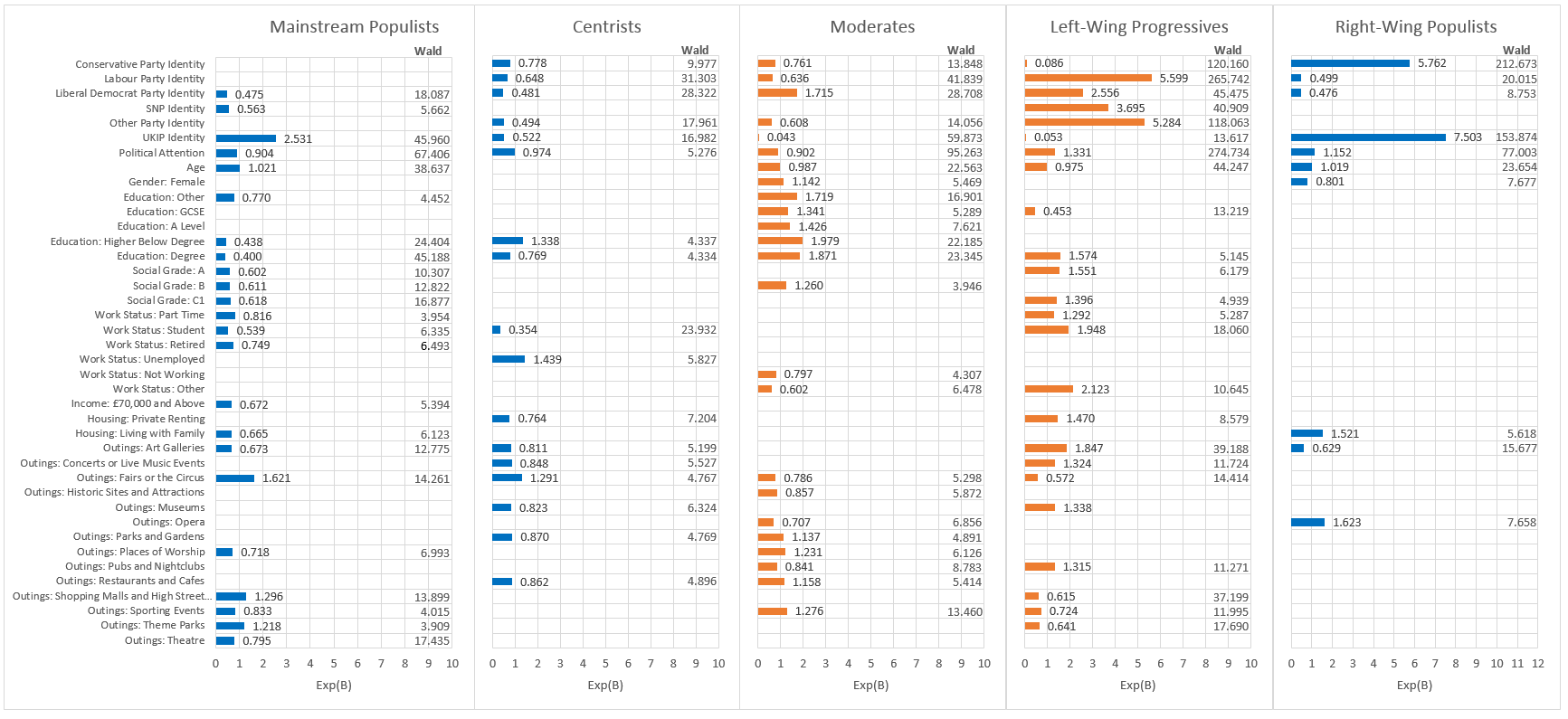
Conservative and UKIP identifiers are between five and seven times more likely than party non-identifiers to be Right-Wing Populists, and the former relationship may reflect the position of historic Conservative identifiers who have dabbled with UKIP support. By contrast, those who identify with all of the other parties are more likely than non-identifiers to be Left-Wing Progressives, with the impact of Labour and other party identity being particularly large. Also notable is the clear indication that party non-identifiers are likely to be Centrists, with almost all party identifiers being less likely to be in that group. Non-identifiers also appear likely to fall into the Mainstream Populist and Moderate groups, with only UKIP and Liberal Democrat identifiers more likely, respectively, to fall into those groups. It is also worth noting that the Wald statistic on the right of each panel, which indicates the relative strength of the relationships, shows that the relationships between ideology and party identity are consistently amongst the strongest in the regressions.
Thus, party identity seems to be particularly related to membership of the Right-Wing Populist and Left-Wing Progressive ideological groups, with non-partisans populating the Mainstream Populist, Moderate, and Centrist groups. This divide is also reflected in the relationship between political attention and ideology, with those who pay more attention to politics being more likely to fall into the two most strongly opposed ideological groups and less likely to fall into the ideological middle ground. These relationships raise questions of causality because it seems plausible that party identity and political interest are core beliefs or dispositions alongside ideology. Thus, rather than suggesting that party identity leads to ideology or vice versa it is more plausible to consider them mutually reinforcing. Thus, ideological beliefs will be affirmed by identification with a party that signals similar positions, whilst party identity will be also strengthened by sharing those positions. At the same time, those with staunch ideological positions are motivated to pay attention to politics and, in doing so, gain information that sustains and strengthens those ideological positions. In other words, ideology and party identity are likely to develop in relation to each other over time.
Issues of causality are considered separately but, for the time being, it is clear that party identity and ideology are intimately related to each other, with the former being by far the strongest predictor of the latter that was included in the models. The strength of these relationships indicates that many in the electorate are opposed both as ideologues and partisans. That said, the majority of the electorate are in the Mainstream Populist, Centrist, and Moderate ideological groups that have weaker relationships with party identity. Thus, there also appears to be a political divide between the staunch and less staunch ideological groups.
[1] Full data was available for 8,503 respondents so the data was reweighted using YouGov’s standard weights for those cases. This produced some large weights, resulting in an effective sample size of 5,377.
 Joe Greenwood-Hau
1 thought on “In Britain, Ideological and Partisan Divides are Aligned”