Question: I have been asked what Arrow’s theorem is by a few students. You probably won’t need to know the answer to this question in detail for many introductory courses on political science, but it may be useful to know in the longer term.
Answer: The first thing to say is that this topic is covered well in Clark, Golder, and Golder, Foundations of Comparative Politics (pp. 209-212). So, if you want a detailed and accessible account of Arrow’s theorem then I suggest referring to that source. However, this is a topic that is often presented in more complex language than necessary, so I will also briefly summarise it here.
Kenneth Arrow argued that, if we want stable decisions to be made, we cannot meet all of the basic criteria for fairness in decision-making that he sets out. Specifically, he argues that for decision-making to be fair it should:
- Not be a dictatorship; decisions should not be made by a small sub-set of people (or just one of them), referred to as the ‘nondictatorship condition.’
- Not exclude those with certain preferences, referred to as the ‘universal admissibility condition.’
- Not deliver an outcome other than the one that most people prefer (i.e. it must actually deliver what has been chosen, not something else), referred to as the ‘unanimity, or pareto optimality, condition.’
- Not change preferences between two items because another item is introduced (e.g. if I prefer political party x to political party y then that should be the case even if political party z arrives on the scene; I might rank z above x and y, below them, or between them, but I don’t suddenly prefer y to x because z has arrived), referred to as the ‘independence from irrelevant alternatives condition.’
Arrow proves that if all of the above conditions are met then it is not possible to arrive at a stable decisions in a group. As an example, imagine that the three blue dots (1, 2, and 3) in the below image (from Wikipedia) are voters, and the three red dots (A, B, and C) are candidates. Voter 1 prefers A to B, and B to C; voter 2 prefers B to C, and C to A; voter 3 prefers C to A, and A to B. Imagine that voters 1 and 3 get together to choose candidate A. Voter 2 can then approach voter 3 and suggest that they instead elect candidate C, which they both prefer to A. But then voter 1 can approach voter 2 and suggest that they elect candidate B, which they both prefer to C. In other words, there is no stable decision outcome; two of the three voters can always align to elect a candidate that they prefer to the one that won.
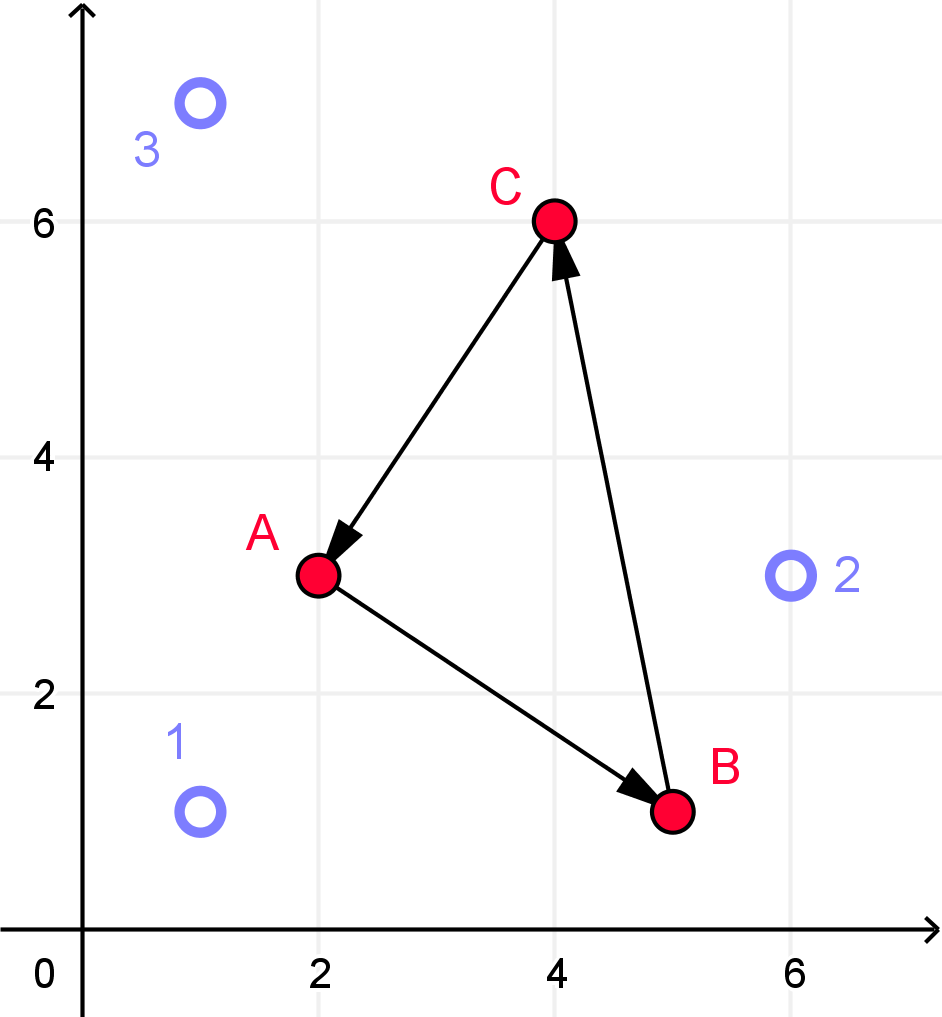
Arrow states that the only solution to this, if we want a stable outcome, is to break one of the above conditions: either one of the voters must become a dictator and choose their preferred candidate (breaking nondicatorship), or they conveniently exclude one of the voters so that the other two can arrive at a stable decision (breaking universal admissibility), or they randomise the decision so that it bears no relation to their preferences (breaking unanimity or pareto optimality), or they introduce another candidate that somehow shifts one of the voters so that they change their rankings of the original candidates (breaking independence from irrelevant alternatives).
In practice, our day-to-day decision-making breaks one of Arrow’s conditions by, for instance, creating an agenda-setter who decides the order or manner that things are voted on, and what options are to be included (e.g. think about how the Brexit referendum question was asked; imagine how it would have affected the outcome if it had been a rank order exercise between ‘hard Brexit’, ‘soft Brexit’, and ‘no Brexit’ instead), and thus has a crucial role to play in the outcome of the vote (and therefore acts as a sort of dictator).
Supplemental question: I read that a nonprofit in the US which ‘studies and advances better voting methods’ is pushing for Approval Voting.
Further, LSE’s Voting Power and Procedures (VPP) research programme brought 22 voting theory specialists to vote to select the “best voting procedure” to elect one out of three or more candidates. They chose as many procedures as they approved of from a list of 18:
- Approval Voting (place an ‘x’ by all candidates you approve of) won with 15 votes.
- Alternative Vote (AV) took second place with 10 votes.
- Plurality Voting (SMP)/First Past The Post (FPTP) received no votes.
So, despite not being used much in practice, I was wondering whether Approval Voting is expected to fulfil more of the criteria of Arrow’s Theorem more often than other systems? Or does it maybe depend on the country?
Answer: Approval voting is an interesting option and worth considering but I am not sure that it helps us overcome Arrow’s theorem. Remember that the theorem is not about how many of the criteria are met, but the impossibility of meeting all of them at once (whilst ensuring a stable electoral outcome), and I do not think that approval voting allows this to be the case. Take the example in the image attached to the above post on Arrow’s theorem, in which we can see that if we gave the three voters the option to exercise approval voting, they would each approve of the two candidates closest to them and refuse to endorse the candidate furthest from them. Thus, each candidate would end up with two votes and the election would be inconclusive (i.e. not a stable outcome). In line with Arrow’s theorem, the only ways around this would be to create a dictator, exclude one of the voters, deliver an outcome unrelated to the votes, or introduce another candidate that somehow changes the voters’ preference rankings of the current candidates. In other words, even with approval voting, we would still have to break one of Arrow’s conditions and, to answer the second question, I don’t think this is country-specific (i.e. it is a universally applicable theory).
 Joe Greenwood-Hau