All posts by Joe Greenwood-Hau

Unknown's avatar

About Joe Greenwood-Hau

I am a Lecturer in Politics in the School of Social and Political Science at the University of Edinburgh, where my teaching focuses on Introduction to Political Data Analaysis and I am wrapping up the Capital, Privilege and Political Participation in Britain and Beyond project. Previously, I was a British Academy Postdoctoral Fellow in the School of Government & Public Policy at the University of Strathclyde, a Teaching Fellow in the Department of Government at LSE, a Data Analyst at YouGov, and a Guest Lecturer in the Department of Government at the University of Essex, where I completed my PhD.

Draft Literature Review: The Causes of Political Participation

Sections: Introduction ->  What is Political Participation? -> The Causes of Political Participation ->  Inequality and Privilege -> Interim Observations ->  Privilege and Capital ->  Adapting Capital -> Reconciling Privilege and Political Participation ->  The Importance of Perception ->  Conclusion


As noted in the introduction the question of why people do or do not participate in politics this is one of the key motivating conundrums of political behaviour research. In seeking a convincing solution to that conundrum it is useful to refer again to the work of Sidney Verba, Kay Lehman Schlozman, and Henry E. Brady in Voice and Equality. Not only do they provide the basis for the above typology of participation but they also advocate moving ‘beyond SES’, or socio-economic status, to focus on how background characteristics translate into trends in political participation.[1] In advocating consideration of how those processes work rather than just observing correlation they adopt an approach to causality, expanded upon below, that informs the one adopted in the current research.[2]

Focussing on the United States, Verba, Schlozman, and Brady’s interest is not primarily in aggregate levels of participation but in who participates, especially in political activity. As expected on the basis of previous research they find that the likelihood of political participation, and the amount of money and time given when participating, reflect the societal cleavages of class (as measured using wealth), race and ethnicity, and gender. Specifically, the wealthy participate in political activity more than do the less wealthy, whilst Anglo-Whites participate more than African-Americans, Latino citizens, and Latino non-citizens in that order, and men participate more than women.[3] Interestingly these patterns of political participation do not apply across the board in relation to religious and secular volunteering. Whilst the same patterns relating to race and ethnicity apply to secular voluntary activity, African-Americans are the most likely to attend religious services and give time and money to their church, which Latinos attend services more than Anglo-Whites but give less time and money.[4] Women are roughly as likely as men to be involved in secular volunteering, and are more likely to be involved in church activities. However, they give the same amount of time and less money when they get involved than do men.[5] This observation of participation in non-political volunteering being less structured by background characteristics fits with the observation that the majority of Americans participate in at least two of secular, religious, and political activity.

Confirmation of the importance of background characteristics in structuring political activity, whilst interesting, is not the purpose of Voice and Equality, which focuses instead on explaining those well-documented patterns. In pursuing that line of enquiry Verba, Schlozman, and Brady begin by considering motivations for political participation. Drawing on rational choice theory, these are identified as selective material (i.e. focussed on material benefits to the individual), selective social (i.e. focussed on social benefits to the individual), selective civic (i.e. focussed on the duty or social expectation of involvement), and policy-based (i.e. focussed on specific policies that spark interest).[6] The possibility that such motivations are post-hoc rationalisations is accepted but, if this is the case, their importance remains because they can influence future behaviour and contribute to the discourse around civic voluntarism.[7]

In the first case, selective material motivations are found to be highly relevant to involvement in work-related political action committees (PACs), contacting representatives about issues of particular importance to one’s self, political organisation affiliation, and church involvement. In the second case, selective social motivations are found to be important for campaigning, protest, political organisation affiliation, and church involvement. In the third case, selective civic motivations are found to be important across the board, though less so in relation to involvement in work-related PACs, contacting representatives about issues of particular importance to one’s self, and non-political organisation affiliation. Finally, policy motivations are found to be generally quite important, and especially so in relation to voting, campaign work, candidate contributions, work-related PACs, issue-based organisation affiliation, contacting representatives about community or national issues, and protest.[8]

Motivations are clearly an important part of the process that leads to political participation and the above findings are of interest in their own right. However, their utility in explaining the processes that lead from background characteristics to political participation is less clear. It seems unlikely that differences in participation between classes, races, and genders, are based on those groups possessing markedly different motivations. If there are, in fact, different trends in motivations between those groups then the reason for those differences would need to be explained. In fact, it seems more likely that there are barriers to participation that affect some groups more than others, regardless of their motivations, and it is this line of thinking that informs the direction of Voice and Equality.

In moving beyond motivations to find a more complete explanation for patterns of political participation Brady, Schlozman, and Verba posit the civic voluntarism model that centres on the importance of resources, engagement, and recruitment. The first of those concepts encompasses the money, time, and civic skills that are at the disposal of individuals.[9] The first two components of resources are familiar but the third, developed in Voice and Equality, requires further explanation. The acquisition of civic skills:

begins early in life in the family and in school and continues throughout adulthood in non-political domains – at work, in organizations, and in church. These civic skills are, thus, developed in the course of activities that have nothing to do with politics: making a presentation to a client, organizing a celebrity auction for a charity, or editing the church’s monthly newsletter. Once honed, however, they are part of the arsenal of resources that can be devoted, if the individual wishes, to politics.[10]

The role of socialisation in transmitting civic skills is apparent and indicates a link from background characteristics to resources. This suggests, in turn that there may be patterns in the distribution of resources between different groups.

Based on the survey data that they gathered for their research Brady, Schlozman, and Verba find that resources are, indeed, distributed unevenly across the population. Education and employment status, which are related to background characteristics, are positively related to income and thus to the resource of money. Free time is more evenly distributed than money, though the unemployed have more of it and, in employment, Latinos have the least, followed by African-Americans and then Anglo-Whites.[11] Of course, there are other factors that impact on time, such as having pre-school or school-aged children to look after, and housework to do, both of which are still more likely to be left to women to deal with.[12] Moving beyond money and time, civic skills are related to job status, with Anglo-White men most likely to have high-level employment and thus the skills that come with it. At the same time, civic skills are also related to the patterns in non-political volunteering noted previously. Thus, whilst White-Anglo men are again advantaged in terms of civic skills by their tendency to be more involved secular voluntary activity, African-Americans and women can gain civic skills from their greater engagement with religious activities.[13] This tendency for churches to provide a route to civic skills for groups that are less involved in high-status work or secular volunteering leads to the suggestion that they act as an equalising force in American political participation in a similar manner to trade unions in Europe.[14]

The second concept posited by the civic voluntarism model to be of importance in political participation is engagement. That concept encompasses interest in politics, belief in the efficacy of political action, level of political information held, and identification with a political party.[15] These components of political engagement are often considered in research on political behaviour, and are commonly understood, so further explanation is not required. Of interest, however, is the fact that their distribution is observed to be uneven and related to background characteristics. In particular, education and income are positively related to all of the components of political engagement except party identification. Further, White-Anglos are more engaged that African-Americans and Latinos in relation to all of the components with the exception that African-Americans have the strongest party identification. Interestingly, gender is of little significance in relation to political engagement although women tend to hold less political information.[16]

Before considering the final component of the civic voluntarism model, recruitment, it is worth noting that Verba, Schlozman, and Brady emphasises the greater importance of resources and engagement. This is because they are considered necessary for political participation to occur whereas recruitment tends to activate those who have the requisite levels of resources and engagement rather than be a necessity in itself.[17] Nevertheless, the fact that recruitment fulfils such a role is important, not least because resources point only to who can get involved in politics, rather than who does.[18] Whilst engagement may suggest who does get involved in politics it is beset by issues of causality because components such as political interest and information could result from political activity rather than cause it.[19] Despite these caveats the impact of resources and engagement, considered further below, on political participation is strong, and is complemented by the impact of recruitment.

The concept of recruitment is not a complex one and is centred on requests to take part in political activities. Such requests may come from an array of sources including family and friends but Brady, Schlozman, and Verba are most interested in those that come in institutionalised contexts such as the workplace, church, or meetings of secular voluntary organisations.[20] In a similar vein to the above observations relating to resources and engagement, there are different patterns of recruitment between groups based on background characteristics. The starkest of those patterns is based on educational level and income (with the former strongly linked to the latter), which are positively related to requests to participate in political activity in the work, church, and secular voluntary organisational settings. Requests are also patterned by race and ethnicity, with Anglo-Whites receiving the most followed by African-Americans and then Latinos. This applies in both the work and secular voluntary organisational settings but in the church setting it is African-Americans who are most likely to receive requests.[21] It is also the case that a higher proportion of men than women are recruited to political activity in church or secular voluntary organisation settings, with a slight trend in the opposite direction in workplaces, though these trends are all slight.[22]

These patterns again point to religious institutions in the United States of America providing a route for otherwise marginalised groups to get involved in politics; not only do they offer a context in which civic skills can be developed but they also act as a source of requests to participate.[23] Of course, there is the risk that those who undertake more political activity subsequently receive more requests for further participation. As with engagement, this poses questions of causality relating to recruitment because we cannot be sure that requests to participate in politics necessarily precede that participation.[24]

The fact that there are causal questions relating to two of the key concepts in the civic voluntarism model, namely engagement and recruitment, suggests the utility of considering Verba, Schlozman, and Brady’s approach to causality. As is common practice in political science they utilise statistical analyses to examine probabilistic relationships.[25] That approach allows them to posit a causal path that begins with background characteristics such as parental class, gender, and race and ethnicity. Those characteristics precede and influence pre-adult experiences of politics at home, education, and extra-curricular activity at high school, which in turn impact on adult institutional involvement such as job status, organisational affiliations, and religious attendance. Ultimately, the preceding stages of the causal path are posited to influence the distribution of the participatory factors that constitute the civic voluntarism model; resources, engagement, and recruitment.[26]

Beyond positing a causal path Voice and Equality dedicates considerable space to testing those propositions, primarily by means of Two-Stage Least Squares statistical analyses. This testing leads to the conclusion that:

The data confirm the existence of two paths from characteristics of one generation to the acquisition of the factors that foster political participation in the next. The starting point of each one is the education of the parents, and respondents’ educational attainment figures importantly in both. One path is more or less socioeconomic. The main effect along this path is the impact of parents’ education on respondents’ education and from there to the job and income levels that they ultimately attain. The second path runs through political stimulation in the home and school. Well-educated parents are more likely also to be politically active and to discuss politics at home and to produce children who are active in high school.[27]

Having established that the proposed causal process leading to the formation of the key factors in the civic voluntarism model is supported by empirical evidence it is useful to turn to the last step in the causal process, that is the impact of the key factors on political participation.

The effects of resources and engagement are found to be wide-ranging and significant. In relation to time-based political activities Verba, Schlozman, and Brady find that civic skills, political interest, political efficacy, and political information are all positively related to participation. Turning to voting, it is found that political interest, partisanship, and political information are positively related to turning out. Unsurprisingly, income is unchallenged as the most significant factor relating to political donating whilst interest and information are positively related to political discussion. There are of course other factors that are found to relate to participation such as education, which is positively related to time-based activity, and citizenship, which is unsurprisingly related to voting.[28] However it is resources and engagement that are, as predicted by the model, found to be crucial components of the causal process that leads to political participation. The third factor in the model, recruitment, whilst arguably activating rather than enabling participation, is also found to be positively related to it.[29]

Building on the posited model Verba, Schlozman, and Brady note that, like recruitment, particular issues can activate political participation. In the mid-1990s when the research for Voice and Equality was being conducted abortion was, as it continues to be today, a major motivating issue in American politics. Focussing on that issue they found that there is a strong link between holding staunchly pro- or anti-abortion opinions and being active in the area. Such activation does not result from all issues on which people hold equally strong opinions so it is not the case that topics the provoke staunch positions are necessarily those that will motivate political activity.[30] Additionally, and crucially, issue activation does not trump the impact of the civic voluntarism model:

For a group that is resource-deprived, issue engagements go only so far in elevating a depressed level of participation. For a group that is well-endowed with participatory resources, issue engagements can give an additional participatory push. Thus, political participation is deeply enmeshed with the substance of politics. Yet the way in which political issues and conflicts are manifest in participatory input also depends fundamentally upon the structure of participatory factors having their origins outside politics.[31]

Thus, whilst acknowledging the importance of other factors, the civic voluntarism model is retained as the primary account of the causal process that leads to political participation.

To summarise, Verba, Schlozman, and Brady present a model that posits a causal path from background characteristics through early socialisation and subsequent organisational affiliation to the key concepts of resources, engagement, and recruitment, which account to a great degree for political participation. Those key concepts draw on well-established components such as income and political interest as well as a new component of resources in the form of civic skills. The posited model, including new and existing components, is tested using survey data gathered for the purpose and found to work as predicted. The model is not intended to be complete and other factors including motivations and issue activation are found to work alongside it without reducing its efficacy. Thus Voice and Equality provides an intellectually convincing and empirically robust account of the mechanisms that translate background characteristics into different patterns of political participation. Crucially, in providing that account it is not attempting to explain away the participatory inequalities that exist between classes, races and ethnicities, and genders but to illuminate how and why those very real inequalities do exist.[32]

Unequal levels of political participation across key societal cleavages are of particular significance because they can contribute to unequal outcomes resulting from the political process. In fact, the voting records of elected representatives have been shown to reflect the opinions and interests of their wealthy constituents, which may be in part because those constituents are more active.[33] The fact that political participation is structured by race and ethnicity, and gender as well as class suggests that the interests and opinions of privileged groups more generally may be better reflected by elected representatives. This lends additional significance to the ultimate and succinct conclusion of Voice and Equality ‘that the voices heard through the medium of citizen participation will be often loud, sometimes clear, but rarely equal.’[34]

Sections: Introduction ->  What is Political Participation? -> The Causes of Political Participation ->  Inequality and Privilege -> Interim Observations ->  Privilege and Capital ->  Adapting Capital -> Reconciling Privilege and Political Participation ->  The Importance of Perception ->  Conclusion

Back to Academic page


[1] Brady, Verba, and Schlozman, ‘Beyond SES’; Verba, Schlozman, and Brady, Voice and Equality, p. 3, pp. 19-20.

[2] Verba, Schlozman, and Brady, Voice and Equality, pp. 24-25.

[3] Verba, Schlozman, and Brady, Voice and Equality, pp. 187-196, pp. 202-204, pp. 231-235, pp. 254-257.

[4] Verba, Schlozman, and Brady, Voice and Equality, pp. 241-247.

[5] Verba, Schlozman, and Brady, Voice and Equality, pp. 260-262.

[6] Verba, Schlozman, and Brady, Voice and Equality, p. 104, pp. 108-112.

[7] Verba, Schlozman, and Brady, Voice and Equality, pp. 97-99.

[8] Verba, Schlozman, and Brady, Voice and Equality, pp. 114-121.

[9] Verba, Schlozman, and Brady, Voice and Equality, p. 271.

[10] Verba, Schlozman, and Brady, Voice and Equality, p. 296, pp. 330-331.

[11] Verba, Schlozman, and Brady, Voice and Equality, pp. 291-294.

[12] Verba, Schlozman, and Brady, Voice and Equality, p. 296, pp. 302-303.

[13] Verba, Schlozman, and Brady, Voice and Equality, pp. 314-317.

[14] Verba, Schlozman, and Brady, Voice and Equality, pp. 332-333.

[15] Verba, Schlozman, and Brady, Voice and Equality, pp. 345-348.

[16] Verba, Schlozman, and Brady, Voice and Equality, pp. 348-350.

[17] Verba, Schlozman, and Brady, Voice and Equality, p. 270.

[18] Verba, Schlozman, and Brady, Voice and Equality, p. 343.

[19] Verba, Schlozman, and Brady, Voice and Equality, p. 344.

[20] Verba, Schlozman, and Brady, Voice and Equality, pp. 372-375.

[21] Verba, Schlozman, and Brady, Voice and Equality, pp. 375-377.

[22] Verba, Schlozman, and Brady, Voice and Equality, pp. 375-377.

[23] Verba, Schlozman, and Brady, Voice and Equality, pp. 380-388.

[24] Verba, Schlozman, and Brady, Voice and Equality, pp. 370-372.

[25] Verba, Schlozman, and Brady, Voice and Equality, pp. 24-25.

[26] Verba, Schlozman, and Brady, Voice and Equality, pp. 416-418.

[27] Verba, Schlozman, and Brady, Voice and Equality, p. 439.

[28] Verba, Schlozman, and Brady, Voice and Equality, pp. 352-364.

[29] Verba, Schlozman, and Brady, Voice and Equality, pp. 388-390.

[30] Verba, Schlozman, and Brady, Voice and Equality, pp. 391-415.

[31] Verba, Schlozman, and Brady, Voice and Equality, pp. 414-415.

[32] Verba, Schlozman, and Brady, Voice and Equality, pp. 522-524.

[33] Bartels, Unequal Democracy, p. 252.

[34] Verba, Schlozman, and Brady, Voice and Equality, p. 532.
Draft Literature Review: What is Political Participation?

Sections: Introduction ->  What is Political Participation? -> The Causes of Political Participation ->  Inequality and Privilege -> Interim Observations ->  Privilege and Capital ->  Adapting Capital -> Reconciling Privilege and Political Participation ->  The Importance of Perception ->  Conclusion


Before examining its causes it is important to consider what is meant by political participation, which is defined in broad terms in the current research. Thus, political participation is here taken to be any attempt by an individual, in interaction with an institution or organisation, to change or conserve an element of society at some level. Within that overarching definition there is, of course, a ‘kaleidoscope’ of political causes that individuals can support but the focus is on the range of modes of participation through which individuals can get involved.[1] The distinctions between those modes are many and varied, from broad differentiation between ‘organized civil society’ and ‘not as well (as in ad-hoc, “temporarily”) organized civil society’,[2] to the more specific typology that ‘categorizes different participation acts according to type of influence, initiative required, level of conflict and scope of outcome.’[3] There has been notable consistency in the distinction between conventional and unconventional participation, with the former described as ‘institutionalised’, ‘traditional’, ‘normal’, and ‘legitimate’.[4] Unconventional participation is not necessarily the opposite; rather it may just be less institutionalised, traditional, normal, or legitimate. The most complete definition differentiates not only between institutionalised and non-institionalised modes but also, within the latter, between the individual, contacting, and collective modes.[5] Importantly, that definition accommodates new forms of participation such as ethical consumerism that have become relevant in recent years.[6] Whilst new in themselves these modes of participation have proven to be no more accessible to new participants.[7]

In contrast to new modes of political participation the most well-established mode, voting, is also the most widely engaged in. However, this has not stopped the case being put for its exclusion from analyses. This is on the basis that it is such a low cost and low benefit activity that it is difficult to usefully consider motives in relation to it.[8] That suggestion was made from a rational choice perspective but has been supported by evidence from the United Kingdom.[9] The limitations of focussing on voting alone, thus, point to the expedience of adopting an inclusive definition of political participation so that the impact of different influences on various modes can be observed.[10]

The different modes of participation that have been identified previously include giving financial support, campaigning in elections, attending meetings, standing for election, and discussing politics with friends, acquaintances, or strangers (especially with the goal of persuading them of something).[11] Elsewhere, other modes have been suggested to include joining organisations, signing petitions, wearing badges, contacting public officials or politicians, and protesting.[12] Ultimately, the broadest definition of participation encompasses both the civic form, including activities such as local religious group involvement and volunteering for charities, and the political form, including all those activities outlined previously.[13] The boundary between those two forms of participation is blurred and each can impact on, and relate to, the other.[14] This distinction draws on the typology developed by Sidney Verba, Kay Lehman Schlozman, and Henry E. Brady in their important work on civic voluntarism.

Demonstrating the centrality of political participation to the work, Voice and Equality: Civic Voluntarism in American Politics begins by outlining key concepts in the area, resulting in the definition of political participation as ‘activity that is intended to or has the consequence of affecting, either directly or indirectly, government action.’[15] They identify the difficulty of measuring political participation and its effects but suggest that its different forms can be arrayed along two spectrums.[16] The first spectrum runs from voting, in which the volume of participation is the same by law (i.e. one person one vote), to making donations to political causes, through which individuals can participate to hugely different degrees (i.e. one donation may be many multiples of another). The second spectrum runs again from voting, which is severely restricted in the amount of information that it can convey about an individual (i.e. only their preferred candidate or party), but this time to direct contact with representatives, which can convey a large amount of complex and in-depth information (e.g. if a face-to-face meeting is arranged).[17]

For Verba, Schlozman, and Brady, political activity must be voluntary and, as such falls within the broader concept of ‘civic voluntarism’ that encompasses other activities such as involvement in neighbourhood groups, religious engagement beyond attendance, or participation in a range of civic bodies such as school boards. Interestingly, they note that there has been less of a decline in civic voluntarism overall than in many areas of political participation in particular.[18] In fact, they find that the vast majority of Americans, who were their subjects, engage in at least two of secular, religious, and political volunteering.[19] Such activity is posited to be linked to, and often to underpin, political participation to the extent that there is a ‘fuzzy border between the two.’[20] In both being inclusive and acknowledging the blurred boundaries between modes their typology of political activity and civic voluntarism fits well with the broad definition of political participation provided at the outset.

Adopting such a broad overarching definition in conjunction with Verba, Schlozman, and Brady’s typology of participation is intended to suggest the political nature of civic engagement. That is to say that by volunteering for a charity or participating in a local community group individuals are, in interaction with an institution or organisation, attempting to change or conserve an element of society at some level. Thus, the current research departs, if only semantically, from the typology of participation presented as part of the civic voluntarism model. It refers to civic engagement instead as implicit political participation whilst those activities referred to previously as political participation are identified as explicit political participation. With this main distinction established it is worth specifying in a little detail the modes that explicit and implicit forms of participation include.

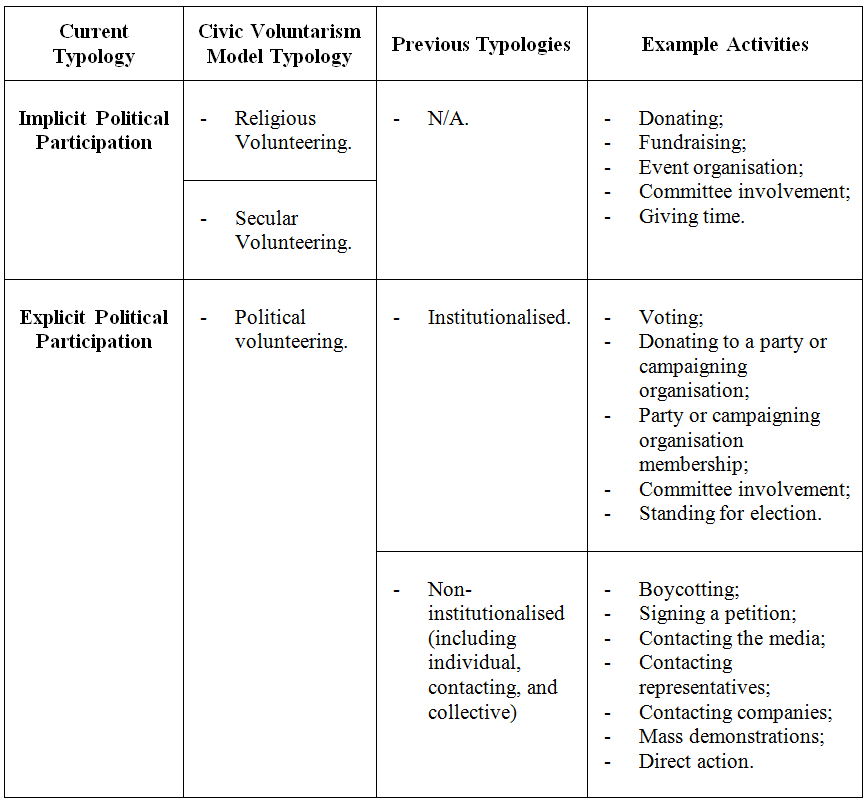
The previously identified distinction between institutionalised and non-institutionalised participation, onto which individual, collective, and contacting modes map, now falls within the domain of explicit political participation. This means that a whole range of activities, from writing a letter to an elected representative to padlocking oneself to the gates of a power station, are encompassed by explicit political participation. Implicit political participation is similarly broad, including as it does all of the secular and religious activities that Verba, Schlozman, and Brady were interested in. As such some modes of implicit political participation are equivalent to modes of explicit political participation and differ only on the basis of the organisation that they relate to. For instance, donating to a charity is considered to be implicit political participation whereas donating to a political party or campaigning organisation is considered to be explicit political participation. Of course, a key defining feature of both explicit and implicit political participation is that they are voluntary, meaning that the current research is not concerned with paid work for any causes. For ease of reference Table 1, presented below, maps Verba, Schlozman, and Brady’s political participation and civic voluntarism onto explicit and implicit political activity alongside previous typologies, and gives examples of each.

Again, it is worth noting that in the United States there has been less of a decline in implicit than explicit political participation, which suggests that there may be different processes at work in relation to each.[21] Of course, the continuing attraction of implicit political participation does not reduce the importance of its explicit counterpart, and it has been convincingly argued that both are necessary for meaningful societal change.[22] This is particularly the case because, as will be outlined below, there is a risk that explicit political participation can become dominated by particular groups, leading to representatives acting more in their interests than those of the general population. The idea of differential access to politics and its outcomes is key to the current research and suggests the need to consider the factors that underpin political participation. Thus, having defined the dependent variable the next sections move on to consider, in somewhat more detail, the independent variables that have been identified to impact on it.


Table 1 – Mapping Implicit and Explicit Political Participation

onto the Civic Voluntarism Model and Previous Typologies 

2014-09-25 Draft Literature Review Table 1

Sections: Introduction ->  What is Political Participation? -> The Causes of Political Participation ->  Inequality and Privilege -> Interim Observations ->  Privilege and Capital ->  Adapting Capital -> Reconciling Privilege and Political Participation ->  The Importance of Perception ->  Conclusion

Back to Academic page


[1] Richard C. Cornuelle, Reclaiming the American Dream (New York, Vintage, 1965), p. 38.

[2] Bruno Kaufman and Johannes W. Pichler (eds.), The European Citizens’ Initiatives: Into New Democratic Territory (Wein, NWV Neuer Wissenschaftlicher Verlag, 2010), p. 63.

[3] Leighley, ‘Attitudes, Opportunities and Incentives’, p. 197.

[4] Reingard Spannring, Günther Ogris and Wolfgang Gaiser (eds.), Youth and Political Participation in Europe: Results of the Comparative Study EUYOUPART (Leverkusen Opladen, Verlag Barbara Budrich, 2008), pp. 16-17; Lester W. Milbrath and M. L. Goel, Political Participation: How and Why Do People Get Involved in Politics? (Chicago, Rand McNally, 1977), p. 20.

[5] Goerres, The Political Participation of Older People in Europe, p. 160.

[6] Spannring, Ogris and Gaiser (eds.), Youth and Political Participation in Europe, p. 23.

[7] John Curtice, ‘Political Engagement Bridging the gulf? Britain’s democracy after the 2010 election’, in Alison Park, Elizabeth Clery, John Curtice, Miranda Philips and David Utting (eds.), British Social Attitudes, The 28th Report (2011-2012 Edition) (London, Sage Publications, 2012), pp. 1-15, pp. 14-15; Milbrath and Goel, Political Participation, p. 20; Kaase, ‘Perspectives on Political Participation’, pp. 783-796; Max Kaase, ‘Social Movements and Political Innovation’, in Dalton and Kuechler, Challenging the Political Order, pp. 84-101; Maloney and van Deth, ‘Conclusions’, p. 237.

[8] John H. Aldrich, ‘Rational Choice and Turnout’, American Journal of Political Science, Vol. 37, No. 1 (Feb., 1993), pp. 247-278, pp. 264-266.

[9] Curtice and Seyd, ‘Is there a crisis of political participation’, p. 98.

[10] Kaase, ‘Perspectives on Political Participation’, p. 793.

[11] Susan E. Scarrow, ‘Political Activism and Party Members’, in Dalton and Klingemann, The Oxford Handbook of Political Behavior, pp. 636-654, pp. 646-650.

[12] Goerres, The Political Participation of Older People in Europe, p. 160.

[13] Cliff Zukin, Scott Keeter, Molly Andolina, Krista Jenkins and Michael X. Delli Carpini, A New Engagement? Political Participation, Civic Life, and the Changing American Citizen (Oxford, Oxford University Press, 2006), pp. 63-64.

[14] Zukin, Keeter, Andolina, Jenkins, and Delli Carpini, A New Engagement, p. 52.

[15] Verba, Schlozman, and Brady, Voice and Equality, p. 9.

[16] Verba, Schlozman, and Brady, Voice and Equality, p. 13.

[17] Verba, Schlozman, and Brady, Voice and Equality, pp. 9-10.

[18] Verba, Schlozman, and Brady, Voice and Equality, pp. 73-79.

[19] Verba, Schlozman, and Brady, Voice and Equality, pp. 81-84.

[20] Verba, Schlozman, and Brady, Voice and Equality, p. 7, pp. 38-39, p. 59.

[21] Verba, Schlozman, and Brady, Voice and Equality, pp. 74-81.

[22] Zukin, Keeter, Andolina, Jenkins, and Delli Carpini, A New Engagement, p. 207; Pattillo-McCoy, Black Picket Fences, p. 208.

Draft Literature Review: Introduction

Sections: Introduction ->  What is Political Participation? -> The Causes of Political Participation ->  Inequality and Privilege -> Interim Observations ->  Privilege and Capital ->  Adapting Capital -> Reconciling Privilege and Political Participation ->  The Importance of Perception ->  Conclusion


From the minister proclaiming that election turnout is important to the anti-cuts campaigner recruiting to their local group there is recognition that democracy, however envisaged, cannot function without public involvement. As such the concern about declining participation amongst those who practice politics has been matched by the piquing of academic interest in the topic.[1] That interest has been additionally keen because of the mixed effects of rising levels of education, which had been anticipated to deliver a participatory dividend, on levels of political activity.[2] However, the focus on those topics is only a contemporary manifestation of one of the key motivating conundrums of political behaviour research: why do people participate or not in political activity?[3]

The idea that politics in the United Kingdom is dominated by those with inherited advantage, supported by the unrepresentative prevalence of privately educated white men in Parliament, is commonplace.[4] It may frequently be filtered through class narratives in public discourse but the idea of privilege is highly relevant to the context of the United Kingdom.[5] Beyond being folk wisdom, though, it is possible that such sentiments point to an answer to the above conundrum. Indeed, research has suggested that despite the emergence of new forms of political activity there remains ‘very little evidence of a more level participatory playing field’ in politics.[6]

Answering the question of why people do or do not participate in politics with the refrain that ‘it’s all down to privilege’, however, is hardly satisfactory. This is not least because the status of that sentiment as folk wisdom suggests that holding such a belief, or perceiving the importance of privilege, is itself an important factor in people’s approaches to politics. Thus, perception of privilege, as well as privilege itself, can be seen to have an important impact on individual political participation. These key concepts of privilege, perception of it, and political participation are each complex in their own right, and it is the job of this chapter to introduce some of the key literature relating to them.

It will begin by presenting a broad definition of political participation and adapting existing typologies to fit with that definition. It will move on to present a convincing account of the processes that lead from background characteristics to unequal political participation, and suggest the link from that work to the concept of privilege. The literature on the various effects of privilege will be presented before the first half of the literature review is rounded off with an identification of the flaws of the preceding literature. In particular it will be noted that a holistic theory of privilege is needed and, crucially, that accounting for objective privilege alone provides an insufficient account of its workings. It will be argued that any fuller account of the concept must also accommodate its subjective component, which is based on perception of privilege.

In addressing the above flaws the second half of the chapter will begin by presenting a convincing and rich holistic theory of the workings of privilege, which is argued to function through economic, social, and cultural capital. It will then adapt that theory to render it applicable in the context of the contemporary United Kingdom before reconciling it with the focus on political participation and the approach to causality adopted in the first half of the chapter. Finally, it will introduce the concept of perception of privilege to address the absence of internal considerations in previous research on the concept. In positing that new concept it will be argued that the chapter lays the groundwork for hypotheses that link the independent variables of privilege and perception of it to the dependent variable of political participation.

Sections: Introduction ->  What is Political Participation? -> The Causes of Political Participation ->  Inequality and Privilege -> Interim Observations ->  Privilege and Capital ->  Adapting Capital -> Reconciling Privilege and Political Participation ->  The Importance of Perception ->  Conclusion

Back to Academic page


[1] John Curtice and Ben Seyd, ‘Is there a crisis of political participation?’, in Alison Park, John Curtice, Katarina Thomson, Lindsey Jarvis, Catherine Bromley (eds.), British Social Attitudes, The 20th Report (2003/2004 Edition): Continuity and change over two decades (London, Sage Publications, 2004), pp. 93-104; Susan E. Scarrow, ‘Declining memberships, changing members? European political party members in a new era’, Party Politics, Vol. 16, No. 6 (May, 2010), pp. 823-843; Peter Mair and Ingrid van Biezen, ‘Party Membership in Twenty European Democracies, 1980-2000’, Party Politics, Vol. 7, No. 5 (2001), pp. 5-21.

[2] Curtice and Seyd, ‘Is there a crisis of political participation’, p. 93; Russell J. Dalton and Hans-Dieter Klingemann, ‘Citizens and Political Behavior’, in Russell J. Dalton and Hans-Dieter Klingemann, The Oxford Handbook of Political Behavior (Oxford, Oxford University Press, 2007), pp. 3-26, p. 14; Henry E. Brady, Sidney Verba, and Kay Lehman Schlozman, ‘Beyond SES: A Resource Model of Political Participation’, The American Political Science Review, Vol. 89, No. 2, (Jun., 1995), pp. 271-294; Sidney Verba, Kay Lehman Schlozman , and Henry E. Brady, Voice and Equality: Civic Voluntarism in American Politics (Cambridge, MA, Harvard University Press, 1995), pp. 73-74.

[3] Max Kaase, ‘Perspectives on Political Participation’, in Dalton and Klingemann, The Oxford Handbook of Political Behavior, pp. 783-796.

[4] ‘The Educational Background of Members of Parliament 2010’, The Sutton Trust, Monday 10 May 2010, viewed at http://www.suttontrust.com/our-work/research/download/29 on 27.08.2013; Afua Hirsch, ‘UK Election results: Number of minority ethnic MPs almost doubles’, The Guardian, Friday 7 May 2010, viewed at http://www.theguardian.com/politics/2010/may/07/black-minority-ethnic-mps-2010 on 27.08.2013; Kira Cochrane, ‘Election results for women to celebrate – and worry about’, The Guardian, Friday 7 May 2010, viewed at http://www.theguardian.com/politics/2010/may/07/women-parliament-election-losses-wins on 27.08.2013.

[5] Nadia Gilani, ‘Snobbery is in a class of its own’, Metro, Monday 07 October 2013, viewed at http://metro.co.uk/2013/10/07/are-you-a-snob-4134407/ on 25.10.2013; Jonathan Freedland, ‘British stereotypes: do mention the war, please!’ The Guardian, Thursday 26 January 2012, viewed at http://www.theguardian.com/world/2012/jan/26/british-stereotypes-please-mention-war on 27.08.2013; Stephanie Flanders, ‘Do we really want more social mobility?’, BBC, Monday 24 June 2013, viewed at http://www.bbc.co.uk/news/business-23040308 on 27.08.2013, and accompanying programme listened to at http://www.bbc.co.uk/programmes/b02yjf15 on 01.07.2013.

[6] William A. Maloney and Jan W. van Deth, ‘Conclusions: Professionalization and individualized political action’, in William A. Maloney and Jan W. van Deth, New Participatory Dimensions in Civil Society: Professionalization and individualized collective action (London, Routledge, 2012), pp. 231-242, p. 241.

It’s as Good as Everyone Says

2014-09-17 Green Yes Campaign

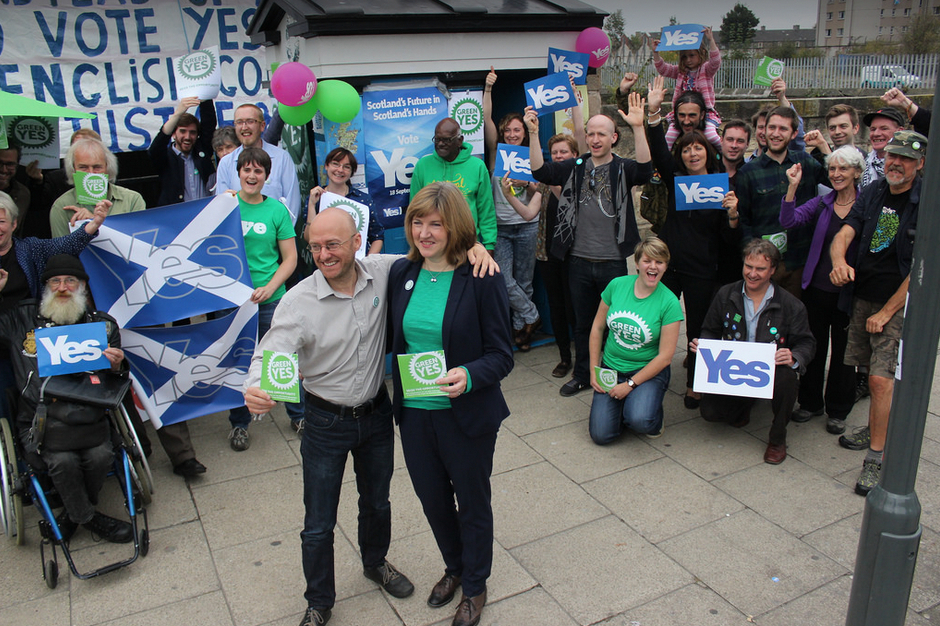
Here we all are outside the ‘Green Yes Tardis’. Thanks to Ric Lander for the photo.


Luckily enough, I had a conference (which turned out to be great) to go to in the exceptionally fine city of Edinburgh last weekend. As such it seemed silly not to stay an extra day and join the campaign for Scottish independence, which is being supported by all of my friends north of the border (and me, obviously). I’d heard talk of how engaging, inspiring, and positive the ‘Yes’ campaign was and my experience of being on the campaign trail on Monday supported this entirely. In an effort to spread the enthusiasm, here’s a post on the highlights of the day.

For many hours I was based at the ‘Green Yes’ police box on Leith Walk, where I encountered dozens of members of the public who are enthusiastically supporting independence. They expressed this by variously putting their thumbs up to us, smiling, shaking our hands, and shouting supportively at us to keep up the good work. The day was filled with smiles and friendliness, both amongst the campaigners and between campaigners and members of the public. In fact, the line between campaigners and public was blurred because so many people shared such a strong commitment to the campaign. Probably my single favourite expression of the public enthusiasm came when, amongst all the cars that had driven past bibbing to show their support, a fire engine loudly honked us with all the firemen inside putting their thumbs up.

Plenty of people, both ‘Yes’ supporters and those who were undecided, took the time to stop and talk to us as well. One of these was an English ex-soldier who wasn’t sure whether to vote even though he lived in Edinburgh. Part of the reason was that he was concerned about the future of the military and wondered what kind of force Scotland would have if it goes independent. As a pacifist this was not natural campaigning territory but I could honestly reassure him that the country would not be without a military and that soldiers in the force would arguably be better looked after than their counterparts in the rest of the UK because none of the military budget would be used to support the (at best hypothetically useful) Trident nuclear missile system. This seemed to be a point that he was particularly open to, and he went away saying that he’d been swayed beyond 51% in favour of independence. This isn’t the reason for counting the conversation as a highlight though. Instead, it was a heartening interaction because it was open, honest, and nonjudgemental. He hadn’t stopped because he wanted to argue, and he wasn’t expecting to hear a particular answer. He told me when he wasn’t convinced by what I was saying but he was still open to hearing more. Likewise, I didn’t feel defensive and was very happy to listen to his different point of view and his concerns. This is how political discussions should be, and what’s remarkable is not only its quality but the fact that it wasn’t a one-off. This kind of public engagement is an incredibly valuable thing regardless of the outcome tomorrow.

Another of the people who stopped to talk to us was a young man who’d only been convinced of the case for ‘Yes’ (by his mum) the day before. He wanted to pick up materials because he was on his way to a friend’s to convince them of the case. The fact that someone who has only started supporting a campaign the day before is immediately becoming active in it is remarkable in itself. Again, this was not a unique experience; plenty of people came to pick up materials not just to convince their friends and families but also their colleagues. This speaks of people being empowered, realising the opportunity for change that is in their hands, and actively taking responsibility for it.

This was also reflected by a pair of teenage lads who slightly sheepishly approached the stall to ask for some ‘Yes’ stickers for their skateboards. When I enthusiastically handed them over they didn’t leave straight away but instead struck up a conversation about how they wanted to convince their friends to vote ‘Yes’, and how they felt it was their responsibility to do so. Then, just as they were about to leave, one of them said that, because of the referendum, he’d gone out and got a job. He said that he didn’t want to be on benefits any more, not because of some stigma but because he felt like there was a future for his country and he wanted to contribute to it. This was a wonderful moment, and represented the perfect manifestation of all the positivity that has been poured into the ‘Yes’ campaign. That positivity is already being reproduced.

I stayed in Edinburgh to join what I suspected would be an amazing ‘Yes’ campaign and I wasn’t disappointed. I encountered enthusiasm and positivity in the streets, met lovely campaigners, and caught up with great friends. Whatever happens in the vote tomorrow, I’m so happy that I’ve been able to share in a campaign that represents the beginning of something so good.

Why I’m Supporting Scottish Independence

Introduction:

Before I leave it too late and the big event passes by I want to get up my reasons for supporting independence for Scotland. Until a few months ago I was an instinctive but wavering ‘Yes’ supporter without any real handle on the arguments either way. Since then I have encountered and been familiarised with a number of those arguments and, at each turn, I have been more convinced that independence is both sensible and emotionally appealing. The main injection of well-rounded arguments came at the Radical Case for Independence event that was hosted by Red Pepper and Open Democracy at Westminster back in June, and I’ve adopted some of those arguments here. Of course, the emphasis is based on what’s important to me and there are other thoughts reflecting conversations that I’ve had with friends in the subsequent three months. This is a mammoth post so I’ve split it into sections: I begin by considering nationality, national identity, and nationalism, move on to economic prospects, and then outline thoughts on government south of the border before finishing on constitutional change. I then conclude that Scottish independence is too good an opportunity to shake up the system to miss.

Nationality, National Identity, and Nationalism:

National identity has never been very important to me and, since I first started thinking about it at school, I’ve considered myself British primarily in terms of formal nationality rather than identity. In other words I’m largely British because I’ve needed to apply for a passport and fill out forms that expect me to have an answer to the question ‘What is your nationality?’ Identity-wise I only define myself as British by default to avoid the more uncomfortable status of being English, which (perhaps unfairly) has more negative connotations for me. Britishness is a very small part of my identity and a part that I’m not particularly keen on.

I have been told that, whether I identify with Britain or not, I’m British because I was born and brought up here and there are things that make me similar to others for whom the same can be said. I find this an unconvincing argument; I believe that we can easily construct or at least priorities elements within our identities and I’m uncomfortable with the expectation that a large part of mine should be defined by a geographical and cultural entity that I’m not especially sympathetic towards. In this light I’m happy with the idea that Scottish independence might bring Britishness into question, or leave it as only a husk concept that people think of as an official designation rather than a meaningful identity. I’m happy to describe myself, amongst other things, as an egalitarian, a democrat, a supporter of immigration, a pacifist, a cyclist, a vegetarian, a comedy-lover, a film-fan, a music-enthusiast, a beer-drinker, and a Cubs supporter. I’ve got enough things to define my identity without needing Britishness.

The potential demise of British national identity does raise the question of nationalism that has been a part of the ‘No’ campaign. They seem to equate, implicitly at least, the call for Scottish independence with the rise of unpleasant nationalist parties across Europe. This would be a worrying idea were it not so patently obviously ridiculous. No one could reasonably categorise the SNP, which is the most right-wing party in the ‘Yes’ camp, as a far-right entity. In addition to this the SNP are very far from being the only group who support independence. There is a huge, diverse, and vibrant progressive movement in favour of independence, something that I witnessed first-hand this past weekend. Both that movement and the SNP have engaged in an overwhelmingly positive campaign that has focussed on building an inclusive, multicultural society that welcomes immigrants, funds state-run services, and reduces inequality. Contrast this with the focus of the ‘No’ campaign on retaining Great Britain (emphasis on the ‘Great’) and stressing the achievements of the country whilst studiously ignoring the terrible things it has done and you can see which side is regressively nationalistic.

The widespread and implicit acceptance of British nationalism makes it more important, not less, to challenge it. Scottish independence would do this. Of course, there is a risk that a stronger vein of British nationalism (albeit with a reduced claim to the former word), or an equally or more unpleasant English nationalism, could emerge. This risk does worry me because such nationalism could have real and unpleasant consequences for some groups in our society. Also, as a person with little national identity, I don’t especially want to live in a highly nationalist society. However, as I’ve just outlined, the ‘Yes’ campaign has shown us something important on this front; it’s possible, even when exclusive nationalism might seem the natural recourse, to build a movement around inclusive goals. If Scotland goes independent there’s an opportunity for the remainder of Britain to be reshaped in multiple ways; a rise in exclusive nationalism is not the pre-defined outcome.

The Economic Prospects:

A big fear that the ‘No’ campaign have tried to instil in voters is that Scotland will be economically worse-off if it goes independent. I think it’s important to acknowledge that there are risks here; as we’re frequently reminded, markets and institutions such as credit rating agencies are conservative and can go nuts when something happens that they don’t like. Scotland will certainly face economic challenges if it goes independent but no more so than any other relatively small independent country does. The idea that Scotland is too small to deal with these challenges on its own is literally ridiculous. There are plenty of examples in Europe alone of economically viable countries of an equivalent or smaller size in terms of geography and population and, crucially, they’re not all rich in natural resources. Every day that those countries exist (and have existed) provides an argument against the idea that Scotland can’t manage on its own. In addition to this Scotland is already a developed country economically with a skilled workforce and decent infrastructure (not-to-mention the insurance of oil revenues that can sustain the economy as it transitions (both to independence and, hopefully, reliance on renewables)), meaning that it has good economic prospects.

Further to the above, if the country goes independent it will no longer be subject to the economic decision-making of Westminster. This is a pretty simple point; MPs at Westminster are supposed to represent the interests of their constituents and thus, in aggregate, of the United Kingdom. The problem is that smaller regions with fewer representatives (even assuming that those representatives are unified) cannot outvote large regions and thus their economic (and other) interests can be consistently subordinated. Those in favour of the union are defending a system that has an inbuilt majority that can (and, based on the responsibility of representatives to advocate for their constituents, is required to) overlook or override the interests of Scotland. I can’t see how this is a more tempting economic proposition for the country than is independent control over its economy. Yes, Scots will be subject to uncertainty and the vicissitudes of the global economy (as everyone is) but at least they can be sure that they won’t be dragged in the wrong direction (for them at least) by the unresponsive British juggernaught.

The idea that there are both economic risks and opportunities reflects another idea: the relationship between economics and politics is not a one-way street. Even assuming that we can find reliable economic predictions, politics should not be about chasing whatever the projections say. This is especially the case since politics can change the context on which those projections are based. Politics isn’t just about doing what’s best based on what we have now, it’s also about thinking about how we can change the context so that things get even better. We should never forget that we are not just subject to economic outcomes; we also have a say over them. Adopting this line of thought makes it clear that, given the greater economic control that would follow, independence represents a great opportunity for Scotland. In the short term there might be economic tremors but independence is about the long-game, in which Scotland is better served by itself than by Westminster.

Government in the Rest of the UK:

Drawing on that theme of change offering opportunity as well as risk (apologies for sounding like an investment banker) I turn to the ‘thousand years of Tory rule’ argument. My first position on this is one that many many people have expressed; if I was Scottish, living in a country that is clearly not dominated by Tories, I would absolutely want to gain independence and cease to be subject to government by that party. Furthermore, as a person living in England, I don’t begrudge them this aspiration. The problem is that the Conservative base of support is, and would continue to be, in England (and to a lesser extent Wales) and there’s a risk for all those non-Conservatives in the remainder of the country that (without the Scottish non-Tory vote) they’ll never constitute a unified-enough majority to elect a government of a non-blue orientation. There are two reasons to discount this risk, the first of which is historical.

There are only four occasions since the Second World War that removing Scottish MPs from the equation would have changed the majority at Westminster: 1964, 1974 (twice), and 2010. Since these are all shifts or potential shifts towards Conservative government it seems that there is something in what the ‘No’ side are saying. This only rings true if we think that nothing has changed since 1974, which is a bit of stretch. It’s more instructive to consider the most recent example, which may also be disheartening: without Scottish MPs we would have a majority Conservative government rather than a coalition at Westminster. However, continuing to focus on recent electoral history, we can see three examples in which the Labour Party has built impressive electoral victories without the need for their Scottish MPs. I believe that it’s reasonable to think that such results could occur again; it might require a different Labour leadership (whatever else you think of them, Blair and his team were good at winning elections) but it’s a plausible prospect. The forced choice between Labour and Conservative alternatives may not be tempting but it’s no different from what we’ve been offered at most elections to Westminster for the last century.

Crucially, the preceding argument is predicated on the status quo in British politics, which leads to the second reason that never-ending Conservative rule south of the border seems less plausible: if Scotland goes independent then things will change in the remainder of the country too. I’ll turn to the possibility of constitutional change below but the point here is that I don’t believe the electorate are incapable of adapting to a new electoral context. Things could change in multiple ways but it seems pretty certain to me that British politics will be different to the extent that we can’t presume uninterrupted Conservative electoral victory.

Constitutional Change:

The British state is an anachronism. It acts as a brake (though fortunately not a block) on change and is very difficult to reform. Tradition has never struck me as a good reason to retain something; lots of entirely unjustifiable things have been defended on the basis of tradition. We shouldn’t look at how long our institutions have been around but at whether they’re any good (and I don’t believe the two things are neatly correlated). First amongst the institutions of the British state is Westminster, a place that has one foot in the eighteenth century. One of the most egregious manifestations of this backward-looking status is, as you might expect me to say, the deficient electoral system that it’s wedded to. Since the Second World War no political party has attracted a majority of the vote (let alone majority support the population including those who don’t vote or don’t register to vote) and yet almost every general election has led to the formation of a majority government by one of those parties. At every election the population has been governed by politicians who garnered only minority support. Accepting electoral defeat in such a flawed system is not part of democracy but anathema to it. I would be willing to accept a government that I disagreed with if it had actually gained the support of a majority of the population; without that basis I believe it’s entirely right to question its democratic legitimacy. More legitimate are coalition governments that actually reflect a majority of the electorate (even if this is an understandably unpopular sentiment to express now). The idea that a party without a majority of the vote has to work to find the common ground with coalition parties seems a better reflection of the complexity of society and public opinion than is a large legislative majority for a party that has not gained most people’s support. And, lest it be said otherwise, there are plenty of examples of electoral systems that are vastly more proportional than ours that function perfectly well and lead to the creation of coalition governments that implement policies and respond to challenges.

But what the hell has Scottish independence got to do with advocating a different electoral system? If Scotland goes independent it doesn’t just mean constitutional change north of the border; there’s also a big opportunity for the remainder of the UK. The basics of the system of government could be seriously questioned in a post-independence UK. This doesn’t just mean the electoral system but also things like the unelected House of Lords, further devolution to Wales, and more regionalisation within England. There might not be much or any change in those areas but, at the very least, they’ll be given a hefty bump up the agenda (both amongst the population and politicians) if the basis of the British state is called into question. Independence would mean Scottish freedom from government by a state that was built in the era of the British Empire, and it would at least offer the opportunity to reshape that state south of the border. Without independence that opportunity looks much smaller. I believe that there are enough progressive people, and people frustrated by the status quo, outside Scotland to bring about meaningful constitutional change in the remainder of the UK. I don’t think Scottish independence would make this less likely (especially since we would have a example of an alternative on our doorstep) but I do think that retaining the British state as it stands does.

Summary and Conclusion:

I will not mourn the loss of British national identity; other parts of identity are far more important to me. Further, I think that the Scottish case would and already does give us an example of how to build movements around causes other than exclusive nationalism, which is an exciting prospect. It seems eminently plausible that Scotland can improve its economic prospects without the deadweight of a political system that mathematically prioritises the majority of the British population that live elsewhere. These points can be seen as a matter of faith: I believe that humans are able to shape the world that they exist in and make it better. The problem is when the structures that they exist in, which may have developed for historical reasons, put a brake on this ability. There’s no doubt in my mind that the British state does this but that Scottish independence could reduce or, at the least, challenge its ability to do so. The plans for devo max essentially admit that Scotland is being held back by Westminster and, as such, beg the question why Scots (or any of us) should accept any government by that outmoded institution. We shouldn’t just accept what Westminster wants to give us, we should decide the shape of the state that we want and pursue it. I’m tired of living in a political system that is predicated on the idea that change ‘cant be done’ or is ‘unrealistic’, and Scottish independence is the biggest opportunity in my lifetime for this to cease to be the case. If I accept the possibility that humans can adapt and build a better world then I have to see the opportunity in change as well as the risk. At the same time, I can’t help but see the huge deficiencies of the British state as it stands, deficiencies that are not just a hypothetical risk. This is a case of the devil we know definitely not being better than the devil we don’t. We need a catalyst for change and Scottish independence represents that. For this reason I am enthusiastically in support.