All posts by Joe Greenwood-Hau

Unknown's avatar

About Joe Greenwood-Hau

I am a Lecturer in Politics in the School of Social and Political Science at the University of Edinburgh, where my teaching focuses on Introduction to Political Data Analaysis and I am wrapping up the Capital, Privilege and Political Participation in Britain and Beyond project. Previously, I was a British Academy Postdoctoral Fellow in the School of Government & Public Policy at the University of Strathclyde, a Teaching Fellow in the Department of Government at LSE, a Data Analyst at YouGov, and a Guest Lecturer in the Department of Government at the University of Essex, where I completed my PhD.

The Dominic Cummings Scandal and Black Lives Matter

‘The elite’ is a nebulous term that is interpreted to mean different things. I tend to think of status hierarchies as spectral rather than having clear-cut lines between groups, meaning it’s difficult to identify ‘the elite’. Nonetheless, there is value in the common intuition that a small number of people have much more power, security, and wealth than most people, wherever we (perhaps arbitrarily) choose to draw the line between the two groups.

It seems reasonable to consider Dominic Cummings to currently be in ‘the elite’ to the extent that he has significant power at a national level, along with the attendant security and wealth. This may be ironic given his supposed loathing of ‘the establishment’, another nebulous term that is not, to my mind, synonymous with ‘the elite’. But there is perhaps a greater irony.

He may have worked very hard, and he may be very intelligent, but he has also been the beneficiary of multi-faceted privilege. He is white, male, heterosexual, able bodied, grew up in a middle-class home, and was privately educated (which implies financial security). This is like a checklist of privileges that make it more likely he would end up (or remain) in the very ‘establishment’ that he apparently so dislikes. Heck, his uncle was a Lord Justice of Appeal. How many people can claim such family connections? Anyway, establishment or not, these privileges certainly eased his path to his current position in ‘the elite’.

As I say, this is not mutually exclusive with hard work or intelligence. I have no idea how Dominic Cummings stacks up in either regard. But privilege has been likened to playing a computer game that’s set to easy. (Albeit life is too important and complex to liken to a game, but for illustrative purposes…). His path to his current position has been made easier at each step because of his multi-faceted privilege.

But, of course, there is a logical flip side to some people being the beneficiaries of structural inequality. There are many other people, and groups, who, rather than being elevated, are oppressed by the social hierarchies that we construct and maintain, designating some as ‘good’ or ‘better’ and others as ‘bad’ or ‘worse’. Those who are not elevated by privilege must, instead, face additional challenges and barriers at each step in their lives (like playing a computer game set to hard, to return to the imperfect analogy).

In relation to black people, this is manifested in deaths in custody and at the hands of the police. Not to mention the daily police aggressions spoken of by black people and indicated by (and I’m talking about the UK here):
– the disproportionate stop and search numbers: https://www.ethnicity-facts-figures.service.gov.uk/crime-justice-and-the-law/policing/stop-and-search/latest?fbclid=IwAR2EIRhzH2YCdN8WOMbSTug94PHslz7mAr8wyBLdRBYTGi_yS-bE1JTmKy4
– the disproportionate arrest numbers: https://www.ethnicity-facts-figures.service.gov.uk/crime-justice-and-the-law/policing/number-of-arrests/latest?fbclid=IwAR0yXCzZ9B1OWcxYV82pA60LnrYqiuMfOV8qkOKUXAhHi2XqwtSRoSwfK8o

And this extends beyond interactions with the police to a multitude of facets of daily life including interactions with other agents of the state, treatment in shops, how people speak or react to you, and portrayal in the media. When you think about the grind of having to put up with daily mistreatment, and of seeing the fatal mistreatment of those in your community, whilst being expected to do so quietly and without complaint, the current protests look incredibly restrained.

So, on one side we have a man who has been the beneficiary of structural privilege and sits in a position of power, security, and wealth.

On the other side, we have a group of people protesting to have their lives respected and valued.

On one side we have a man who has publicly been shown to have broken rules and possibly endangered other people’s lives, who not only goes unpunished but is protected and defended.

On the other side we have a group of people who have been expected to put up with being punished for doing nothing wrong, and who are wrongly suspected, attacked, and mistreated in their daily lives.

It is the same system of social inequality that produces both outcomes. This is what happens when social hierarchies are created and sustained. Some win. Many lose.
In Britain, the Causes of Ideological Difference Remain Opaque

In other posts I have looked at the partisan divides between, and demographic and cultural profiles, of ideological groups in contemporary Britain, and it seems that Left-Wing Progressives are particularly distinctive. Measures included in analysis of new survey data help to provide a much better account of that ideological group than its Mainstream Populist, Centrist, Moderate, or Right-Wing Populist counterparts. This raises questions of causality, which cannot be answered using cross-sectional survey data but require future attention.

The model considered here was created to account for membership of five distinct ideological groups. This provided results indicating the specific relationships between variables (which can be seen in Chart 1 at the bottom of this post) but the focus here is on assessing the overall performance of the model in accounting for ideological position. With logistic regression this assessment is done with reference to the Cox & Snell R Square statistic. In this case, the figure indicates the extent to which the model accounts for whether or not respondents fall into each ideological group. Crucially, it is strikingly different for each of the ideological groups. At one end of the spectrum the figure for Centrists is 0.038, indicating that the variables included in the model are not, collectively, important factors in helping us understand why people are in that ideological group or not. At the other end of the spectrum the figure for Left-Wing Progressives is 0.309, indicating that the model is best at accounting for this ideological disposition and that people who hold such views are the most politically, socially, and culturally distinctive of the five groups that were considered.[1]

The performance of the model in relation to each of the ideological groups raises important issues of causality. What does it mean to say that the model ‘helps us understand’, or ‘is better at accounting for’, one ideological group or another? I have argued that ideology and party identity are likely to develop in relation to each other over time, and it is likely that they have their roots in early or formative years. This means that they may precede many of the demographic variables that were measured recently, such as current or recent work status, income, housing circumstances, cultural activities and possibly education. So, when statistically significant relationships are identified between those factors and ideological group, do we know whether one causes the other, vice versa, or just that they may be related in some way? The latter, most conservative, interpretation seems most convincing.

Therefore, whilst we can be confident that economic, social, and cultural circumstances have some relationship with political ideology, we cannot be equally confident of the causal direction of those relationships. Indeed, it may be that the model does not include key factors, some of which could be very difficult to measure, such as the ideological, cultural, or educational context that people were brought up in. The data do not contain information on the psychological experience that people had as they grew up, how their families and teachers expressed ideas or spoke about politics (if at all), or what educational priorities or cultural activities were emphasised (if any). Such factors may shape people’s subsequent ideological beliefs, party identities, educational levels, incomes, social grades, and cultural activities, amongst other things.

It seems likely that the ways in which people think about and understand the world shape their decision-making from an early age, and thus the circumstances in which they subsequently find themselves. At the same time, it is also plausible that such circumstances influence people’s beliefs about the world over their lifetime. This suggests the need to recognise both that circumstances influence and are influenced by beliefs, perhaps with some early circumstances and core beliefs having a lasting influence. However, these relationships cannot be disentangled using the cross-sectional data that underpin the models in question.[2] Thus, it has been shown that political ideology is intimately related to party identity and political attention, and that it is also related to background characteristics and cultural milieu. However, the question of precisely how economic, social, and cultural circumstances relate to political ideology remains open. Questions like this should be a key focus for research relating to political beliefs and behaviour. This is why the approach of the new Social Action as a Route to the Ballot Box project, using Understanding Society data, is so important, and why we need more such work.

Chart 1 (click to enlarge)

[1] The figures for the other ideological groups are:

  • Mainstream Populists: 0.114
  • Moderates: 0.083
  • Right-Wing Populists: 0.167

[2] The survey data that was gathered by YouGov for a research project on authoritarian populist ideologies that was led by Joe Twyman at Deltapoll. The results of that project were presented at the Professor Anthony King Memorial Conference at the University of Essex. Whilst the data underpinning the identified ideological clusters was gathered at the same time, the other background, political, and cultural variables were gathered previously and held by YouGov. Nevertheless, many of those variables are self-reported at a particular time and data on how they have developed over time or what their values were in the past is unavailable, meaning that I cannot conduct time-series analysis to investigate the relationships between variables over time.

In Britain, Ideological and Partisan Divides are Aligned

As the big Brexit date approaches, analysis of new survey data shows that key contemporary ideological divides in Britain are strongly related to party identity, even after taking into account a range of other factors. Particularly striking is the relationship between Right-Wing Populist ideology and both Conservative and UKIP party identity, as well as the strong association between Left-Wing Progressive ideology and Labour or other party identification. Together those relationships indicate a political landscape in which the two most staunchly opposed ideological groups are also on opposing sides of the partisan divide. Crucially, the strength of those relationships also sets the two groups apart from the remaining Mainstream Populist, Centrist, and Moderate groups, for whom party identity is more weakly related to their ideological beliefs.

Political ideology is often conceived of as a set of underlying beliefs that structure specific beliefs and political decisions. Likewise, the party that people identify with can be considered a core belief that shapes other beliefs and decisions, and is thus expected to be related to ideology. To test this possibility, a series of logistic regressions were run on new survey data to identify the factors that are related to membership of five different ideological groups. The survey data that was gathered by YouGov for a research project on authoritarian populist ideologies that was led by Joe Twyman at Deltapoll. The results of that project were presented at the Professor Anthony King Memorial Conference at the University of Essex. Those results were based on a cluster analysis that identified five distinct ideological groups:

  • Mainstream Populists
  • Centrists
  • Moderates
  • Left-Wing Progressives
  • Right-Wing Populists

The subsequent logistic regressions were exploratory in nature and, along with measures of party identity, included YouGov’s standard demographic variables covering age, gender, education, social grade, work status, income, and housing tenure, as well as a measure of political attention. Also included were indicators of the cultural activities that people participate in, which will be considered separately.

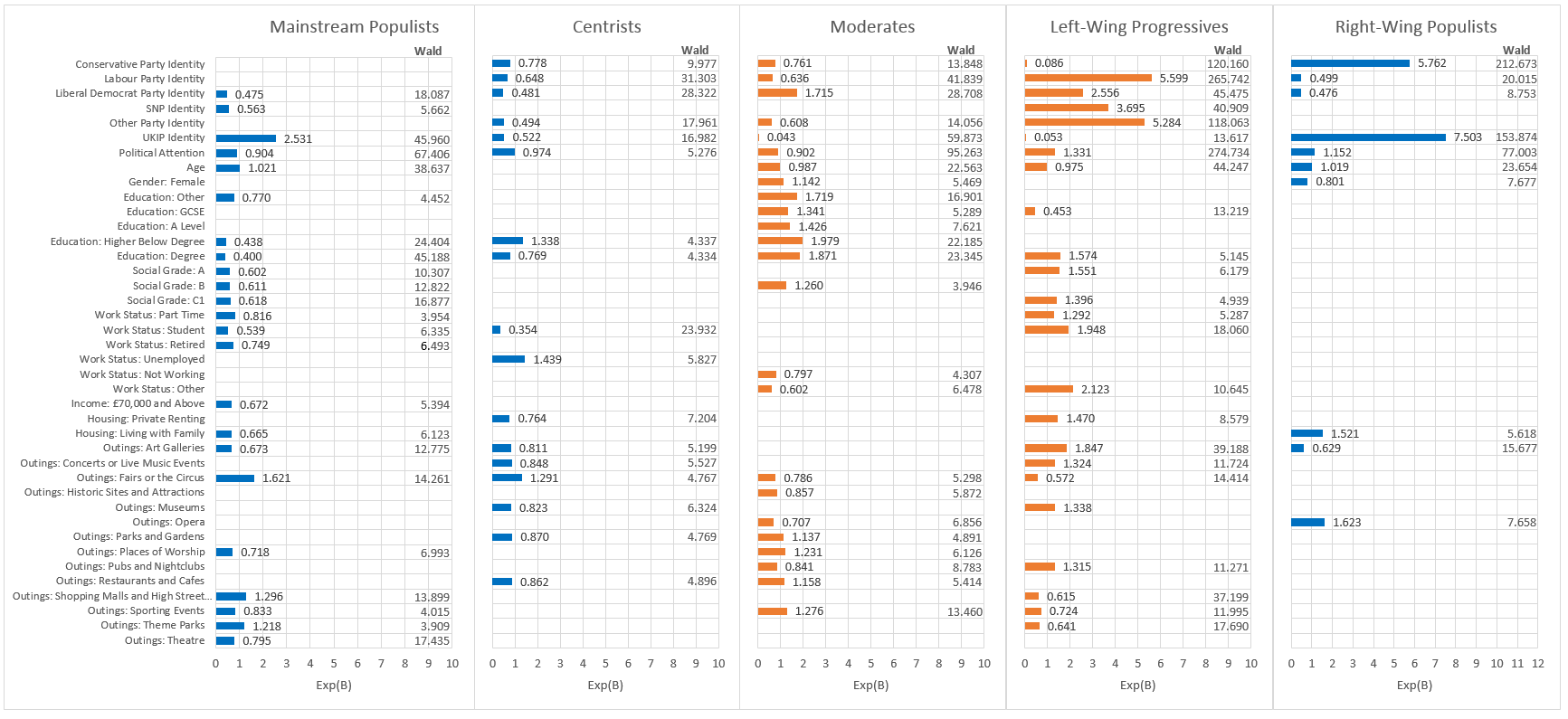
The results of the logistic regressions relating to each ideological group are presented in Chart 1, in which only the significant relationships (at the 5% level) are represented by bars. For party identity, the reference category against which the other groups are compared is those respondents with no party identity. The chart presents the unlogged odds (indicated by the Exp(B) statistic) of being in each ideological group that is associated with each of variables in the model. [1] These can be interpreted as the likelihood of being in each ideological group, with figures above one representing a higher likelihood and figures below one representing a lower likelihood. The results indicate a striking relationship between party identity and ideological group.

Chart 1 (click to enlarge)

Conservative and UKIP identifiers are between five and seven times more likely than party non-identifiers to be Right-Wing Populists, and the former relationship may reflect the position of historic Conservative identifiers who have dabbled with UKIP support. By contrast, those who identify with all of the other parties are more likely than non-identifiers to be Left-Wing Progressives, with the impact of Labour and other party identity being particularly large. Also notable is the clear indication that party non-identifiers are likely to be Centrists, with almost all party identifiers being less likely to be in that group. Non-identifiers also appear likely to fall into the Mainstream Populist and Moderate groups, with only UKIP and Liberal Democrat identifiers more likely, respectively, to fall into those groups. It is also worth noting that the Wald statistic on the right of each panel, which indicates the relative strength of the relationships, shows that the relationships between ideology and party identity are consistently amongst the strongest in the regressions.

Thus, party identity seems to be particularly related to membership of the Right-Wing Populist and Left-Wing Progressive ideological groups, with non-partisans populating the Mainstream Populist, Moderate, and Centrist groups. This divide is also reflected in the relationship between political attention and ideology, with those who pay more attention to politics being more likely to fall into the two most strongly opposed ideological groups and less likely to fall into the ideological middle ground. These relationships raise questions of causality because it seems plausible that party identity and political interest are core beliefs or dispositions alongside ideology. Thus, rather than suggesting that party identity leads to ideology or vice versa it is more plausible to consider them mutually reinforcing. Thus, ideological beliefs will be affirmed by identification with a party that signals similar positions, whilst party identity will be also strengthened by sharing those positions. At the same time, those with staunch ideological positions are motivated to pay attention to politics and, in doing so, gain information that sustains and strengthens those ideological positions. In other words, ideology and party identity are likely to develop in relation to each other over time.

Issues of causality are considered separately but, for the time being, it is clear that party identity and ideology are intimately related to each other, with the former being by far the strongest predictor of the latter that was included in the models. The strength of these relationships indicates that many in the electorate are opposed both as ideologues and partisans. That said, the majority of the electorate are in the Mainstream Populist, Centrist, and Moderate ideological groups that have weaker relationships with party identity. Thus, there also appears to be a political divide between the staunch and less staunch ideological groups.

[1] Full data was available for 8,503 respondents so the data was reweighted using YouGov’s standard weights for those cases. This produced some large weights, resulting in an effective sample size of 5,377.

Reflections on the 2017 General Election Polls

2018-09-24 MRP Model Performance

2015 and 2016 were not good years for polling companies in the UK, with the general failure of the industry to predict the outcome of the 2015 general election, and then a mixed bag of results in advance of the EU Referendum. The industry’s response to both those events has continued a long trend in the history of polling: innovating to address past mistakes. The inquiry into the 2015 polling miss informed the industry that it needed to improve its sampling in terms of political support and engagement, and age. By contrast, the outcome of the EU Referendum somewhat endorsed the accuracy of online polls at the expense of phone polls, with the latter struggling to reach less educated people, who were more likely to vote Leave. The good news for the industry is that the 2017 general election polls indicate that polling companies have addressed some of the problems that beset them in the preceding two years.

The underlying data gathered for the 2017 polls tended to be closer to the outcome of the general election than the adjusted headline figures that were often released, indicating three things. First, the industry has gone a long way in addressing the sampling problems identified by the inquiry into the 2015 polling miss. Second, the general shift from phone to online polling since the EU Referendum has the capacity to deliver data that is as high, or higher, quality. Third, it remains remarkably difficult to model turnout. Joining these points together, the error that afflicted some companies’ results stemmed not as much from the underlying data as from the tweaks that were applied in the weighting of data, especially to try and account for the varying likelihoods of people turning out to vote. Indeed, there was a tendency for more severe turnout adjustments to lead to worse published results. A good example here is Survation, who applied minimal adjustment to their data on the basis of likely turnout and produced the most accurate conventional polling result.

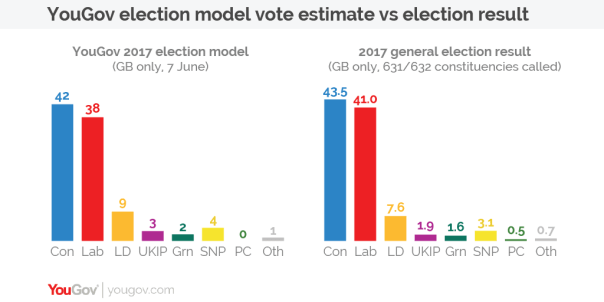
Beyond the improvements made to the quotas used by companies to ensure the representativeness of their samples, and the continued difficulty of modelling turnout, the 2017 polling results indicate an interesting new direction for the industry. They demonstrate the potential for complex models to predict the outcomes of elections with a remarkable degree of accuracy. Specifically, an approach called multi-level modelling with post-stratification (or MRP for short), trailed by Ben Lauderdale (of the London School of Economics) and Doug Rivers (of Stanford University), predicted the outcomes of 93% of seats accurately. Crucially, MRP required accurate data to work, which in this case was provided by YouGov, again indicating the important steps that companies have made in improving their sampling.

Whilst MRP demonstrates the potential rewards of innovation, both it and traditional methods also show the continued importance of treating polls as snapshots of public opinion. The change in support for the Conservatives and Labour over the course of the campaign shows how important it is not to treat the numbers on any given day as definitive. This speaks of the predictive limitations of polling; on one level it is not that impressive, having directly asked tens of thousands of people how they’re going to vote, to predict the outcome of an election only one day, or a few days, before it happens. There is hardly any causal distance between the questions asked and the outcomes predicted. It would be rather more impressive if predictions were made a year, or even a month, in advance based only on demographics, psychological dispositions, or voter preferences in other areas. This, however, remains beyond the capacity of the social sciences perhaps because, as Gary Younge has pointed out, politics is an ever-changing beast. This suggests that whilst the polling industry has continued its noble tradition of adapting in order to address its past mistakes, this tradition will have to extend into future as society continues to evolve.