Sections: Introduction -> What is Political Participation? -> The Causes of Political Participation -> Inequality and Privilege -> Interim Observations -> Privilege and Capital -> Adapting Capital -> Reconciling Privilege and Political Participation -> The Importance of Perception -> Conclusion
Before examining its causes it is important to consider what is meant by political participation, which is defined in broad terms in the current research. Thus, political participation is here taken to be any attempt by an individual, in interaction with an institution or organisation, to change or conserve an element of society at some level. Within that overarching definition there is, of course, a ‘kaleidoscope’ of political causes that individuals can support but the focus is on the range of modes of participation through which individuals can get involved.[1] The distinctions between those modes are many and varied, from broad differentiation between ‘organized civil society’ and ‘not as well (as in ad-hoc, “temporarily”) organized civil society’,[2] to the more specific typology that ‘categorizes different participation acts according to type of influence, initiative required, level of conflict and scope of outcome.’[3] There has been notable consistency in the distinction between conventional and unconventional participation, with the former described as ‘institutionalised’, ‘traditional’, ‘normal’, and ‘legitimate’.[4] Unconventional participation is not necessarily the opposite; rather it may just be less institutionalised, traditional, normal, or legitimate. The most complete definition differentiates not only between institutionalised and non-institionalised modes but also, within the latter, between the individual, contacting, and collective modes.[5] Importantly, that definition accommodates new forms of participation such as ethical consumerism that have become relevant in recent years.[6] Whilst new in themselves these modes of participation have proven to be no more accessible to new participants.[7]
In contrast to new modes of political participation the most well-established mode, voting, is also the most widely engaged in. However, this has not stopped the case being put for its exclusion from analyses. This is on the basis that it is such a low cost and low benefit activity that it is difficult to usefully consider motives in relation to it.[8] That suggestion was made from a rational choice perspective but has been supported by evidence from the United Kingdom.[9] The limitations of focussing on voting alone, thus, point to the expedience of adopting an inclusive definition of political participation so that the impact of different influences on various modes can be observed.[10]
The different modes of participation that have been identified previously include giving financial support, campaigning in elections, attending meetings, standing for election, and discussing politics with friends, acquaintances, or strangers (especially with the goal of persuading them of something).[11] Elsewhere, other modes have been suggested to include joining organisations, signing petitions, wearing badges, contacting public officials or politicians, and protesting.[12] Ultimately, the broadest definition of participation encompasses both the civic form, including activities such as local religious group involvement and volunteering for charities, and the political form, including all those activities outlined previously.[13] The boundary between those two forms of participation is blurred and each can impact on, and relate to, the other.[14] This distinction draws on the typology developed by Sidney Verba, Kay Lehman Schlozman, and Henry E. Brady in their important work on civic voluntarism.
Demonstrating the centrality of political participation to the work, Voice and Equality: Civic Voluntarism in American Politics begins by outlining key concepts in the area, resulting in the definition of political participation as ‘activity that is intended to or has the consequence of affecting, either directly or indirectly, government action.’[15] They identify the difficulty of measuring political participation and its effects but suggest that its different forms can be arrayed along two spectrums.[16] The first spectrum runs from voting, in which the volume of participation is the same by law (i.e. one person one vote), to making donations to political causes, through which individuals can participate to hugely different degrees (i.e. one donation may be many multiples of another). The second spectrum runs again from voting, which is severely restricted in the amount of information that it can convey about an individual (i.e. only their preferred candidate or party), but this time to direct contact with representatives, which can convey a large amount of complex and in-depth information (e.g. if a face-to-face meeting is arranged).[17]
For Verba, Schlozman, and Brady, political activity must be voluntary and, as such falls within the broader concept of ‘civic voluntarism’ that encompasses other activities such as involvement in neighbourhood groups, religious engagement beyond attendance, or participation in a range of civic bodies such as school boards. Interestingly, they note that there has been less of a decline in civic voluntarism overall than in many areas of political participation in particular.[18] In fact, they find that the vast majority of Americans, who were their subjects, engage in at least two of secular, religious, and political volunteering.[19] Such activity is posited to be linked to, and often to underpin, political participation to the extent that there is a ‘fuzzy border between the two.’[20] In both being inclusive and acknowledging the blurred boundaries between modes their typology of political activity and civic voluntarism fits well with the broad definition of political participation provided at the outset.
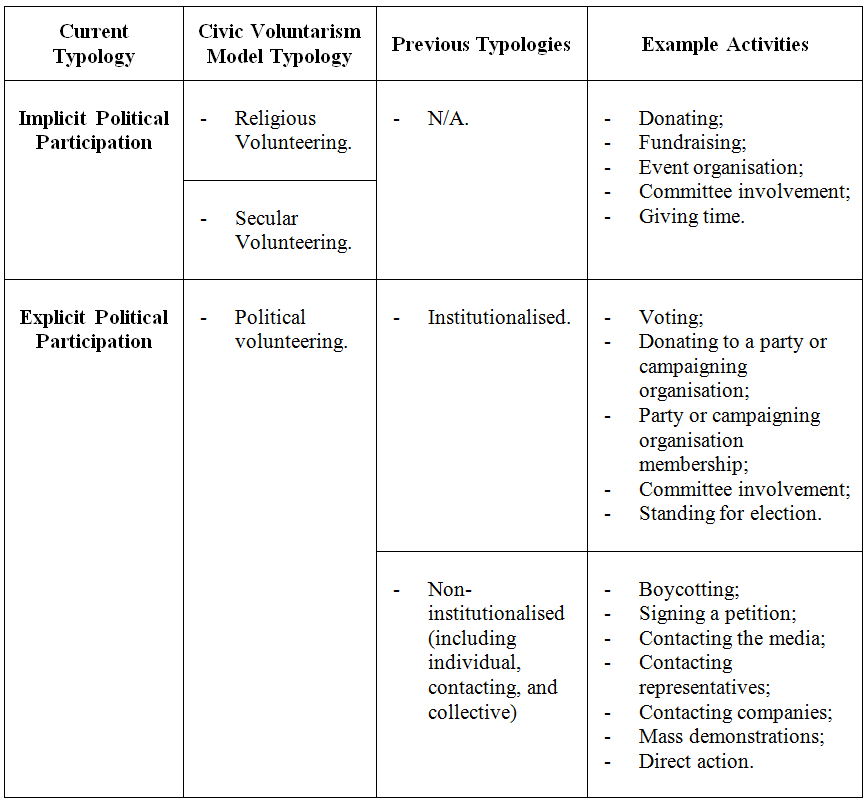
Adopting such a broad overarching definition in conjunction with Verba, Schlozman, and Brady’s typology of participation is intended to suggest the political nature of civic engagement. That is to say that by volunteering for a charity or participating in a local community group individuals are, in interaction with an institution or organisation, attempting to change or conserve an element of society at some level. Thus, the current research departs, if only semantically, from the typology of participation presented as part of the civic voluntarism model. It refers to civic engagement instead as implicit political participation whilst those activities referred to previously as political participation are identified as explicit political participation. With this main distinction established it is worth specifying in a little detail the modes that explicit and implicit forms of participation include.
The previously identified distinction between institutionalised and non-institutionalised participation, onto which individual, collective, and contacting modes map, now falls within the domain of explicit political participation. This means that a whole range of activities, from writing a letter to an elected representative to padlocking oneself to the gates of a power station, are encompassed by explicit political participation. Implicit political participation is similarly broad, including as it does all of the secular and religious activities that Verba, Schlozman, and Brady were interested in. As such some modes of implicit political participation are equivalent to modes of explicit political participation and differ only on the basis of the organisation that they relate to. For instance, donating to a charity is considered to be implicit political participation whereas donating to a political party or campaigning organisation is considered to be explicit political participation. Of course, a key defining feature of both explicit and implicit political participation is that they are voluntary, meaning that the current research is not concerned with paid work for any causes. For ease of reference Table 1, presented below, maps Verba, Schlozman, and Brady’s political participation and civic voluntarism onto explicit and implicit political activity alongside previous typologies, and gives examples of each.
Again, it is worth noting that in the United States there has been less of a decline in implicit than explicit political participation, which suggests that there may be different processes at work in relation to each.[21] Of course, the continuing attraction of implicit political participation does not reduce the importance of its explicit counterpart, and it has been convincingly argued that both are necessary for meaningful societal change.[22] This is particularly the case because, as will be outlined below, there is a risk that explicit political participation can become dominated by particular groups, leading to representatives acting more in their interests than those of the general population. The idea of differential access to politics and its outcomes is key to the current research and suggests the need to consider the factors that underpin political participation. Thus, having defined the dependent variable the next sections move on to consider, in somewhat more detail, the independent variables that have been identified to impact on it.
Table 1 – Mapping Implicit and Explicit Political Participation
onto the Civic Voluntarism Model and Previous Typologies
Sections: Introduction -> What is Political Participation? -> The Causes of Political Participation -> Inequality and Privilege -> Interim Observations -> Privilege and Capital -> Adapting Capital -> Reconciling Privilege and Political Participation -> The Importance of Perception -> Conclusion
[1] Richard C. Cornuelle, Reclaiming the American Dream (New York, Vintage, 1965), p. 38.
[2] Bruno Kaufman and Johannes W. Pichler (eds.), The European Citizens’ Initiatives: Into New Democratic Territory (Wein, NWV Neuer Wissenschaftlicher Verlag, 2010), p. 63.
[3] Leighley, ‘Attitudes, Opportunities and Incentives’, p. 197.
[4] Reingard Spannring, Günther Ogris and Wolfgang Gaiser (eds.), Youth and Political Participation in Europe: Results of the Comparative Study EUYOUPART (Leverkusen Opladen, Verlag Barbara Budrich, 2008), pp. 16-17; Lester W. Milbrath and M. L. Goel, Political Participation: How and Why Do People Get Involved in Politics? (Chicago, Rand McNally, 1977), p. 20.
[5] Goerres, The Political Participation of Older People in Europe, p. 160.
[6] Spannring, Ogris and Gaiser (eds.), Youth and Political Participation in Europe, p. 23.
[7] John Curtice, ‘Political Engagement Bridging the gulf? Britain’s democracy after the 2010 election’, in Alison Park, Elizabeth Clery, John Curtice, Miranda Philips and David Utting (eds.), British Social Attitudes, The 28th Report (2011-2012 Edition) (London, Sage Publications, 2012), pp. 1-15, pp. 14-15; Milbrath and Goel, Political Participation, p. 20; Kaase, ‘Perspectives on Political Participation’, pp. 783-796; Max Kaase, ‘Social Movements and Political Innovation’, in Dalton and Kuechler, Challenging the Political Order, pp. 84-101; Maloney and van Deth, ‘Conclusions’, p. 237.
[8] John H. Aldrich, ‘Rational Choice and Turnout’, American Journal of Political Science, Vol. 37, No. 1 (Feb., 1993), pp. 247-278, pp. 264-266.
[9] Curtice and Seyd, ‘Is there a crisis of political participation’, p. 98.
[10] Kaase, ‘Perspectives on Political Participation’, p. 793.
[11] Susan E. Scarrow, ‘Political Activism and Party Members’, in Dalton and Klingemann, The Oxford Handbook of Political Behavior, pp. 636-654, pp. 646-650.
[12] Goerres, The Political Participation of Older People in Europe, p. 160.
[13] Cliff Zukin, Scott Keeter, Molly Andolina, Krista Jenkins and Michael X. Delli Carpini, A New Engagement? Political Participation, Civic Life, and the Changing American Citizen (Oxford, Oxford University Press, 2006), pp. 63-64.
[14] Zukin, Keeter, Andolina, Jenkins, and Delli Carpini, A New Engagement, p. 52.
[15] Verba, Schlozman, and Brady, Voice and Equality, p. 9.
[16] Verba, Schlozman, and Brady, Voice and Equality, p. 13.
[17] Verba, Schlozman, and Brady, Voice and Equality, pp. 9-10.
[18] Verba, Schlozman, and Brady, Voice and Equality, pp. 73-79.
[19] Verba, Schlozman, and Brady, Voice and Equality, pp. 81-84.
[20] Verba, Schlozman, and Brady, Voice and Equality, p. 7, pp. 38-39, p. 59.
[21] Verba, Schlozman, and Brady, Voice and Equality, pp. 74-81.
[22] Zukin, Keeter, Andolina, Jenkins, and Delli Carpini, A New Engagement, p. 207; Pattillo-McCoy, Black Picket Fences, p. 208.
 Joe Greenwood-Hau