Category Archives: Politics

Report on the Launch of the 2015 Audit of Political Engagement

Introduction:

This morning I was at the launch of the Hansard Society’s 2015 Audit of Political Engagement, which is, as always, a laudable and valuable piece of work. For those of you who don’t want, or don’t have time, to read the whole report (and couldn’t make it to the launch) I thought I’d summarise what was said. I’ll stick to the structure that they used, but I’ve also written a separate post (with a little more with opinion) on what was said by the two MPs who were invited to pass comment at the launch.

I always await the Audit with a mixture of excitement and trepidation, the former because it’s a fascinating piece of work, the latter in case it answers all the questions I’m focussing on in my own research. This year was no exception and, fortunately, they rewarded my excitement and proved my trepidation misplaced (though, from a less self-interested perspective it would be brilliant to have the Hansard Society looking into the structural and perceptual influences on political engagement). The launch event was at Parliament, which is fitting given that the focus is on engagement with that institution, though I worry that it makes it less accessible to the public at large. Still, it was open to those who wanted to attend, and was constituted by a succinct summary of some key points emerging from the data.[1] These can be grouped under the headings of the election effect, perceptions of Parliament, and the EU referendum.

The Election Effect:

There appears to have been a post-election bounce in political engagement, with some areas showing much higher levels than in 2014. More people reported certainty to vote (up by 10% to 59%), interest in politics (up by 8% to 57%), knowledge of politics (up by 8% to 55%), satisfaction with politics (up by 7% to 33%), and a sense of efficacy (up by 3% to 35%). As you can see, the latter two areas have much lower levels of engagement than the others, which has also consistently been the case in the past. In addition, I noticed a trend that wasn’t commented on; there were distinct peaks in many of these areas in both 2010 and 2015 (i.e. general election years) with an apparent decline in between.

The above trends in engagement hold across age groups although, despite the positive movement, young people were still the least likely to report certainty to vote (39% compared to 59% overall). At the same time, the Audit recorded the highest level of party support (41% being either very or fairly strong party supporters) since the beginning of the series in 2004. I’m intrigued by whether the link between the increased engagement amongst younger people and increased party support could be, in part, the ‘Corbyn effect’, which has been widely reported to have engaged younger people.

Interestingly however, the above uptick in engagement was counterbalanced by a decline in the sense of influence at the national level reported by respondents (13% feel influential compared to 17% in 2014). As is commonly the case, the reported sense of influence was also lower at national level than at local level (with 25% feeling influential at local level), whilst also being lower than the reported desire to be involved at both local and national level (46% and 41%, respectively wish to be involved at those levels). Thus, more people wish to get involved in politics than think they can influence it, perhaps because it doesn’t necessarily make sense to get involved with a system that you can’t influence, even if you’d like to. Of course, this is an abiding problem of political engagement; people need to get involved to influence politics but they won’t feel influential unless they get involved (and perhaps not even then).

Perceptions of Parliament:

Net reported knowledge of Parliament is now positive for the first time since the Audit began (i.e. more people report being knowledgeable than report not being knowledgeable, by a whopping 5%), though it would be interesting to see some measures testing knowledge (which should relate to both local and national contexts, and practical and abstract knowledge) alongside the question on self-perceived knowledge. There were also increases (again, between 2014 and 2015) in the number of respondents agreeing that Parliament ‘holds government to account’ (up by 7% to 42%), ‘encourages public involvement in politics’ (up by 3% to 28%), ‘is essential to democracy’ (up by 12% to 73%), ‘debates and makes decisions that matter to me’ (up by 10% to 58%). This very positive looking slew of findings, it was pointed out, could be another result of the election effect.

Satisfaction with Parliament also increased (by 5% when compared to the 2013 Audit, when it was last asked) but still stands at only 32%, which is lower than in the first Audit in 2004. Satisfaction with MPs continues to be higher in relation to local MPs (35% satisfied) than in relation to MPs in general (29% satisfied), though the gap is closing due to a big (6%) bump in satisfaction with MPs in general (perhaps surprisingly). Despite the closing gap, this remains a good example of the paradox of distance, in which people rate their local services (e.g. schools or hospitals) and the people they have encountered (e.g. immigrants they know or their local MP) more favourably than they do those services (e.g. education or health) or groups (e.g. immigrants or MPs) in general. This could be logical because it is reasonable to assume that the national picture or a wide group of people will include more variation than the specific service or person you’ve encountered and thus may not be as good overall. Also, it could be explained on the grounds that that people are likely to be more favourable towards what they know and have experienced than they are towards distant or abstract concepts. Of course, a more pessimistic interpretation could be that people are disposed to be negative towards (or prejudiced against) some services and groups generally despite encountering examples of them being good individually.

Moving on, the Audit suggested that undertaking political acts continues to be a minority pursuit. Indeed, even in terms of willingness to undertake an act in the future (rather than reporting having done so in the past), only contacting an MP or Peer had more than half (52%) saying they would do it. Willingness to create or sign a paper petition came in second (with 35%, closely followed by paper petitions with 34% willing to create or sign one), and these two areas constitute by far and away the most used, or potentially used, routes to engage with politics. Importantly, almost all of the areas of political activity had increased in terms of both reported acts and willingness to act in future, which could well be another result of the general election. Lastly in this section, there was a statistically significant increase (the only time this was reported) in the belief that Prime Minister’s Questions deals with the important issues facing the country, and in agreement that it is grounds for pride in Parliament, though both are still very low (45% and 17% agreement respectively (despite each being up by 5% compared to 2014)).

The EU Referendum:

As a kind of footnote to the presentation of the results it was reported that there are high levels of interest and intent to vote in the EU referendum (63% interested, 59% certain to vote), coupled with low levels of satisfaction with and knowledge of the EU (21% satisfied, net -24% feel knowledgeable). It was thus suggested that there may be too much heat and not enough light in the debate around the referendum. This suggestion appeared to be contradicted by one of the MPs on the panel, who argued that people need to feel less like the referendum is a debate over technicalities between bureaucrats and more like it matters to day-to-day life, though I don’t think those two things are mutually exclusive. It’s possible to outline technical information about the referendum and relate it to the meaningful ways in which the outcome could impact on people’s lives. As with politics in general, the aim should be to strike a balance between being passionate and being informed, which can be a tough one to get right.

Conclusion:

All of the above was fascinating but I felt the launch was lacking in terms of considering who is engaged with politics. Are some groups more interested than others? Do some groups report undertaking more political acts than others? These are the questions relating to political engagement that underpin my research, along with questions of why any such differences between groups exist. Fortunately, the Hansard Society had a ready-made response in the form of the following summary paragraph (in the Audit and on the website) relating to inequalities in engagement:

‘Generally, the most politically engaged in the Audit series tend to be male, older, white, higher educated, affluent, home-owning citizens. The social class gap in electoral participation continues to rise: there is now a 37 percentage point difference between the certainty to vote levels of those in social classes AB and DE, an increase of six points in 12 months. However, the gap between the social classes tends to be much smaller in relation to questions about satisfaction with politics and institutions. Younger people (aged 18-24) are also more likely to be satisfied with the politics and institutions of our political system, and have a greater sense of their own potential to influence it than are other more generally engaged groups. This is also true of BME adults, although they are much less likely to say they have actually undertaken some form of political action than white adults in the last year.’

I find the first two sentences in the above the most striking, and I will certainly be reading the report more closely with them in mind. I also hope that when I finish my research (ideally sooner rather than later) I will be able to shed at least a sliver of light on why those discrepancies exist.


[1] In terms of methodology, the Audit is a time series study in its thirteenth year, and can be seen as an annual health check on the state of political engagement in the United Kingdom. The survey that all of the results are based on was fielded last December, by Ipsos MORI, to a representative sample of 1,231 British adults across Great Britain (i.e. excluding Northern Ireland). The Audit should not be used at the basis for predictions, rather it is a snapshot at particular moment in time. It presents a complex and contradictory picture, which is unsurprising given people’s lukewarm attitudes towards Parliament (and politics).
On a Relative’s Benefits Tribunal

A few Fridays ago (fortunately not on Easter Friday) I got up early and caught the train to Cambridge, where I needed to attend the County Court. This was so that I could be present whilst a close relative went through a tribunal to appeal the withdrawal of her Disability Living Allowance and the Personal Independence Payment (PIP) element of the benefits that replaced it. I am writing this post is to give an insight into the effect of the current (and last) government’s policies on disability benefits both on a recipient from whom they have been (partially) withdrawn and, much less importantly, on someone who’s not a recipient (i.e. me).

To give some context, my relative has been diagnosed with Borderline Personality Disorder (BPD) and has been signed off work by her GP for the last seven years. For those of you who wish to know more about the condition, you can read about it here, here, or here. My experience of having a relative with BPD is that she is fine most of the time but experiences episodes of acute depression or anxiety and self-harm. These can be more predictable, for instance when they are associated with a time of year, or less predictable, for instance when they are triggered by a negative experience, but there is always the possibility that such an episode is just around the corner. The likelihood of such an episode is reducing as my relative gets better at dealing with the patterns and triggers that affect her, as those around her improve their understanding of BPD, and also as the health service gets better at supporting people with such conditions. Still, the risk of an episode is ever-present, and is heightened when the government’s squeeze on spending threatens provision of things like the Complex Cases Service, which provides excellent support to those with personality disorders. The threat of closing such services is a threat to remove a safety net from those who demonstrably need it. It is worth noting that the government’s approach to limiting spending not only means that benefits are withdrawn from recipients but also that support services are closed or reduced at the same time, thus doubly impacting on users.

The last time my relative had a severe mental health episode was on the day that she received notification that her PIP was to be withdrawn by the Department of Work and Pensions (DWP, still headed at the time by Iain Duncan Smith). It is clear that receipt of the letter from the DWP played an important part in triggering the episode. That was in October 2015, and my relative has had periods of acute anxiety and depression since then due to the fact that she has had her income notably reduced and has spent the entire period with an approaching tribunal hanging over her. It is testament to her resilience that she has borne the brunt of preparing for the tribunal and sought appropriate advice and support from Citizens’ Advice Bureau (CAB, one of the first services to be cut as a result of the last (and now the current) government’s austerity agenda), from Complex Cases, and from a friend who works for Unite the Union.

The particularly unpleasant twist in the above is that her very capacity to appeal the withdrawal of her PIP might be seen by some as evidence that she could get a job and cease receipt of benefits. Such a view is based on a fundamental misunderstanding of my relative’s condition, and this is a problem with the government’s assessment system that is being implemented by ATOS. By that assessment system’s reckoning my relative can make a cup of tea, cook for herself, and clean herself so she should not be entitled to PIP. It doesn’t matter that she has periodic and, at times, severe mental health episodes (which can be triggered, for instance, by the stress associated with a full-time job), the fact that she is physically able most of the time means that she doesn’t qualify. My relative’s capacity to live her life is mostly due to her own abilities but it is also, in part, to do with the support available to her from family, from friends, and from the state. All of those things are needed and they complement each other; the state can’t replace family or friends but neither can family and friends provide the financial support and mental health services that the state offers. The withdrawal of any one of those sources of support creates a more precarious situation for my relative.

When I arrived at the court on that Friday a few weeks ago my relative seemed fine (she can be good at hiding inner turmoil from those around her). As the time passed, however, it became increasingly apparent that the stress of being assessed (having already been assessed once by ATOS) was hard to bear. She was impatient for the tribunal to start and desperate for it to be over and to know the result. After the hour of the tribunal itself, during which I waited outside and my relative was supported by a lawyer from Citizens’ Advice Bureau, she emerged in tears. This was not because the tribunal panel itself had been horrible (indeed they approached the situation with admirable humanity) but because my relative had to prove that she deserved to receive the financial support that enables her to live her life. In some way, even despite the decency of the panel members, my relative was on trial, being asked to prove that she had a condition that justifies the support she receives. Never mind that her relatives and friends, her GP, and the staff who support her at Complex Cases had no doubts that she needed PIP. Never mind what the people who know her best think, a series of tick-boxes on an ATOS assessment form meant that my relative had to bear the burden of proving her right to receive support from the state.

The good news is that, after a short but tense period of deliberation (during which we waited outside), the tribunal panel ruled in favour of my relative, awarding her the standard payment from the DWP (including back-payment). This affirmed my broad faith in the British justice system,[1] and I’m thankful to the panel members (who I will probably never meet) and the lawyer from CAB who supported my relative. Still, she had to live through five months with her PIP withdrawn and a tribunal approaching. Thus, this government’s policies on disability benefits (even before the recent budget, resignation of Iain Duncan Smith, and subsequent capitulation on the part of the government) have had a direct negative impact on my relative and an indirect negative impact on me. I don’t for a moment resent or regret offering support to my relative, but I do oppose a government policy that places stresses and demands on those in receipt of benefits and also their families and friends. I had to balance attendance at the tribunal alongside my research, my teaching, and completing job applications, which was a psychologically exhausting experience. Whilst I don’t think this is the most important impact of the government’s benefits policies I do think that we should assess policies on all of the impacts that they have, and we can’t ignore the possibility that placing stress on recipients of benefits has a ripple effect that impacts on those around them as well.

I have tried to avoid hyperbole and generalisation in what I’ve written here, and provide insight into this particular case. However, I think we can safely say that the experience of my relative is not unique. Indeed, I also have a friend who has had to go through a tribunal to prove his chronic health condition warrants PIP payments (which, of course, it does, as his tribunal ruled). Further, I imagine that there are many who do not necessarily have the knowledge or skills to challenge the withdrawal of their benefits (my relative has resolved to used her experience to help such people). So, the cases that I know are not necessarily examples of the people who are most in need of help and support, and this puts me in mind of a conversation that I had with a friend before the 2010 general election. He was arguing that it will make little difference which party is elected because the country will largely continue to run regardless (e.g. bins will be collected, schools will stay open, and trains will keep running). I pointed out that it was very unlikely to be privileged people like us (we’re both educated, financially secure, white, heterosexual men with no disabilities or chronic health conditions) who would be significantly affected by a change in government. Rather, it is the less privileged who are most vulnerable to changes in government policy, and it seems clear to me that this has been the case since 2010. Indeed, I now have personal experience of the negative impact that the austerity agenda can have on someone who receives support from the state.


[1] On the basis of its capacity to make evidence-based decisions that challenge the unjust consequences of government policy, and thus to provide recourse for those who might not otherwise have it. In that light, let’s not even get started on cuts to legal aid.

The Cathie Marsh Lecture on the Polling Miss

Back in November last year I attended the annual Cathie Marsh Memorial Lecture at the Royal Statistical Society, which was excellent (as it has been when I’ve attended before). The focus of the lecture was on polling failure and the future of survey research, and it was delivered by Professor Patrick Sturgis, who is chairing the inquiry into the performance of the polls preceding the general election. Given that the polling inquiry is due to release its results this week, I thought this would be an opportune moment to record my record and interpretation of the points made by Prof. Sturgis back in November. To be clear, the following is a mix of his and my thoughts, so if you’re interested in seeing Prof. Sturgis’ own words then you can watch the full lecture here.

The lecture began, rightly, with some kind words remembering Cathie Marsh, before engaging in a little definition. To wit, it is possible to differentiate between polls and surveys on the grounds of snootiness, quality, and purpose. Taking the latter two, more defensible, grounds, it has been argued that surveys are higher quality than polls (based, as they usually are, on random (or at least closer to random) samples) and that their purpose is broadly investigatory (i.e. academic) rather than political or democratic. Crucially, the point was made that this distinction is now less rigid than it was in the past. Still, even if the distinction between the two is less rigid, the fact that surveys and polls are arguably distinct on the basis of quality didn’t seem to bode well for the latter. Like any good academic, though, Professor Sturgis was quick to introduce a note of complexity.

It’s not as simple, he argued, as saying ‘the pollsters got it wrong’. Indeed, they did a good job in predicting the UKIP vote, the SNP surge, and the Liberal Democrat collapse so it was just, alas, on the ‘main event’ that they went skew whiff. Whilst the latter point may seem the most salient, Prof. Sturgis went on to remind the audience that without polls there may be a growth in even less accurate speculation about the outcomes of elections. There is certainly a healthy dash of truth in his statement that we couldn’t do better on that front by relying on twitter, facebook, and equivalent sources.[1] This, of course, does not mean that we should settle for polling as it is (and, in my experience, the polling companies have far from rested on their laurels since May), especially in light of the historical trend that was outlined wherein polls have increasingly underestimated the Conservative share of general election votes whilst at the same time overestimating the Labour share. This may mean, as remarked, that we are now using something that measures pounds to measure ounces (if you’ll forgive the imperial units).

With the magnitude of the problem established (it’s not great but still better than it could be), Prof. Sturgis turned to possible explanations for the polling miss, all of which have been circulating since the day after the general election:

  1. Late swing. In other words, a load of people might have changed their minds just before they voted (and largely moved to the Conservatives) thus rendering the polls, which were conducted at the latest a day before, wide of the mark.[2]
  2. Sampling and weighting. As Prof. Sturgis pithily put it, polls are ‘modelling exercises based on recruited samples’. So, maybe the polling companies have recruited the wrong people to the panels of respondents that they survey, or perhaps they had out-of-date or incorrect assumptions underpinning the weights that they apply to their samples to correct for unrepresentative recruitment.
  3. Turnout misreporting. Perhaps a load of people who said they were sure they’d vote and that they would do so for Labour ended up not being able to make it to polling stations. At the same time, perhaps more of the people who said they’d vote Conservative managed to actually do so in practice.
  4. Don’t knows or refusals. If the people who said they didn’t know who they’d vote for, or who refused to say, broke to the Conservatives more than Labour then it could explain the disparity between the polls and the election result.
  5. Question wording. If the questions that are asked do not prompt a similar decision-making process to the one that people go through before they actually cast their vote then they may give a different answer.[3]
  6. Voter registration and postal voting. It may be that issues with registering to vote disproportionately affected voters for one party (i.e. Labour), or that those who held postal votes were not accurately taken into account. As Prof. Sturgis pointed out, this is unlikely to be the case since there were relatively small numbers in both groups.

We’ll come back to which of the above explanations is most convincing but, before doing so, it was noted that the polling companies’ results were surprisingly similar given their methodological differences. This may have suggested uncoordinated herding by the companies, whereby they looked at each other’s results and adjusted their methods to replicate those of their competitors (based on fear of being too far from the pack). This is obviously important (and related to the point about polling as a ‘modelling exercise’ above) but it’s an issue that needs to be considered separately from the original cause(s) of the disparity from the election result.

Since you’re reading this I guess you’re aware of at least some of the implications of all the above but, we were helpfully reminded. Namely, such a high-profile polling miss is likely to reduce public interest in polls and surveys on the basis that, their trust (along with that of the media and politicians) has been dented. This could have the knock-on effect of further reducing response rates, making it even harder for pollsters and survey researchers to gain accurate results in future. This is something that the polling companies appear acutely aware of; I wouldn’t go so far as to call this an existential threat to them but it’s obviously had serious reputational repercussions and could continue to make their business harder for some time.

Despite the above, Prof. Sturgis went to some effort to moderate concerns, suggesting (unexpectedly) that the polling miss will actually have a relatively minimal impact. First, it’s rather difficult to estimate election results, in part because respondents are best at answering questions about their recent behaviour rather than about what they will do in the future. Thus, it shouldn’t be too much of a surprise that the polls get it wrong at times, which links to the previous point about measuring ounces with an instrument for pounds. Second, returning to the opening distinction between polls and surveys, it is likely that the damage will impact more on the former than the latter because surveys with samples that were recruited through more other means (such as the exit poll (which could also ask about recent behaviour rather than future behaviour), and the British Election Study face-to-face survey) did a better job of approximating the outcome. It is important that Prof. Sturgis referenced this distinction again at this point in the lecture, as will be seen below. Third, a number of different research designs (phone and online, varying in proximity to randomness) failed to predict the result so no particular company is implicated, meaning the consequences will be spread between them. Fourth, the rise of opt-in panels (which are low cost, have a rapid turnaround, allow for ever-increasing functionality, and can accommodate client involvement in survey design) seem inexorable, so the polling miss is unlikely to stop it.

The final of the preceding points (which links to his preceding restatement of the distinction between polls and surveys) is key, because Prof. Sturgis went on to note the increasingly difficult time that those who conduct random sample surveys have. Response rates are falling (even more so with random digit dialling phone surveys than face-to-face) so it takes more time and effort to get the same response rate, meaning that costs also rise. Thus, in certain key senses random sample survey research is increasingly suffering by comparison to opt-in panels. This is a paradox in the sense that it is also random sample surveys, as noted above, that did a better job of predicting the outcome of the general election. And thus, we return to which of the possible explanations for the polling miss seems most likely to account for it. The focus of much of the latter part of the lecture on the difference (in quality) between random sample (survey) research and opt-in panel (polling) research suggests that sampling and weighting are likely to be the main culprits (though other explanations may well have a part to play), and this is a position that is supported by work that has been done by both the British Election Study team and the British Social Attitudes survey team (both of which have random samples). It is also supported by Prof. Sturgis’ comment that there is not a great deal of value in those who adopt a random sample approach chasing non-response. This is an unnecessary additional cost (for an already expensive method of gathering data) and random sampling is already better than non-probability opt-in panel based sampling. Thus, Prof. Sturgis concluded, reports of the death of random sample surveys are exaggerated.

So, what do we, or at least I, take from this? Well, if sampling and weighting were the main problem with the general election polls, which seems perfectly plausible, then the repeated distinction between surveys (based on random samples) and polls (based on samples drawn from opt-in panels) becomes particularly salient. This is especially so for those working with survey research in academia (especially quantitatively orientated social science), because survey methodology is a whole sub-field of academia on its own, and because it reflects an ongoing debate about whether opt-in panel samples (usually online) are good enough to base robust academic research conclusions on.[4] The polling miss, and Prof. Sturgis’ lecture, seems to suggest that the latest point in that ongoing debate favours the sceptic’s point of view. In other words, it may now be harder for those who conduct research based on opt-in panel samples (such as myself) to convince academics to trust our results.

And what about beyond academia? I was recently asked why all this fuss about polling really matters. My answer was that some in the media may feel that they were led up the garden path by polling companies and were therefore implicated in ‘misleading’ the public, who may now be less trusting of both polling companies and the media. Crucially, there is also the argument that the media focus on the ‘horse-race’ that was supplied by the polls took attention away from the policy positions and political issues that should have been reported on more, which may have influenced the outcome of the election (which would be pretty important if it could be proved to be true).[5] This is especially problematic because the race that took so much attention turned out to have a much clearer winner than had been anticipated. So, the polling miss is important because it has implications for public trust of polls, and the media that report them, which means that it has implications for how, and whether, the media report them in future. This means that it may also have implications for future election campaigns and perhaps even results. As I have said, the polling companies (and media) seem to be taking these implications very seriously, as demonstrated by their full cooperation with the inquiry. The release of that inquiry will make the precise nature of the aforementioned implications clearer, so I’ll certainly be paying attention to it.


[1] If anyone who’s critical of polls or survey research ever tries to make a point about what people think based on what they’ve seen on social media then I implore you to call out this contradiction.

[2] Notably absent from this list is the idea of ‘shy Tories’, or people who don’t want to admit to polling companies that they vote Conservative. This was a big part of the explanation for the polling miss at the 1992 general election but seems much less likely to be part of the problem this time round.

[3] There’s absolutely tons of research on the impact of question wording (down to minute levels detail), and this informed the approach of those who conducted the Exit Poll, which asked respondents to repeat the voting process with a replica ballot paper and ballot box, rather than just answering a survey question. This, along with their targetting of a representative sample of polling stations, may have contributed to the high level of accuracy that the Exit Poll achieved.

[4] If you’re interested in looking into this debate you can start with the following two articles that represent the two sides:

Neil Malhotra and Jon A. Krosnick, ‘The Effect of Survey Mode and Sampling on Inferences about Political Attitudes and Behavior: Comparing the 2000 and 2004 ANES to Internet Surveys with Nonprobability Samples’, Political Analysis, Vol. 15, No. 3 (Summer, 2007), pp. 286-323 [presenting evidence that non-probability samples drawn from internet panels may produce less accurate results].

David Sanders, Harold D. Clarke, Marianne C. Stewart, and Paul Whiteley, ‘Does Mode Matter for Modeling Political Choice? Evidence From the 2005 British Election Study’, Political Analysis, Vol. 15, No. 3 (Summer, 2007), pp. 257-285 [presenting evidence that non-probability samples drawn from internet panels may produce results that are not (statistically) significantly different from random face-to-face samples in terms of the relationships between variables].

[5] I’ll go out on a limb and state that I don’t think this will be proven any time soon; it’s remarkably difficult to prove the impact of particular factors in election outcomes, and this would take quite a lot of (quite expensive) academic research to provide robust evidence (if that’s even possible now that the event has passed), and with no guarantee of a clear conclusion.

It’s as Good as Everyone Says

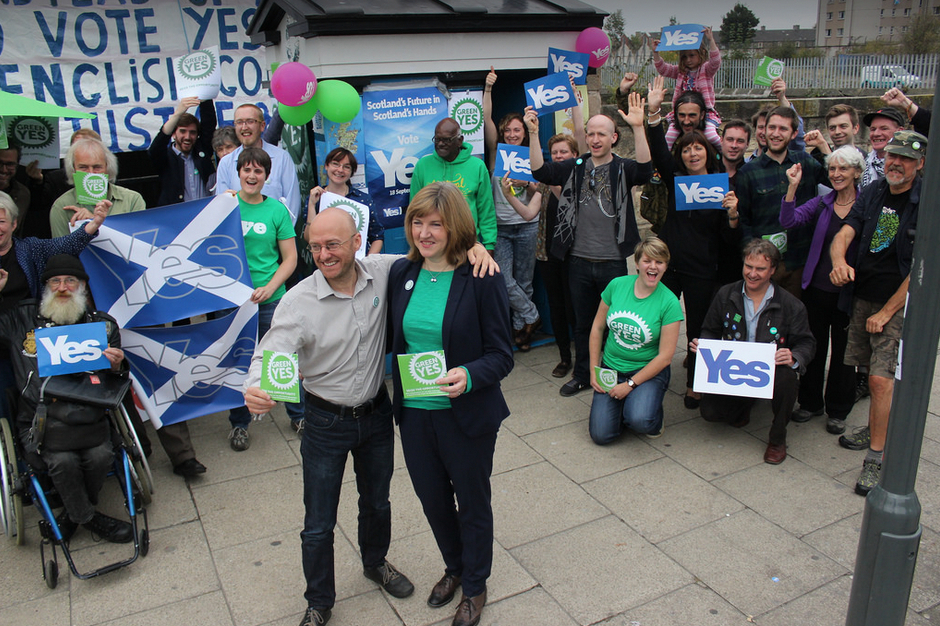
2014-09-17 Green Yes Campaign

Here we all are outside the ‘Green Yes Tardis’. Thanks to Ric Lander for the photo.


Luckily enough, I had a conference (which turned out to be great) to go to in the exceptionally fine city of Edinburgh last weekend. As such it seemed silly not to stay an extra day and join the campaign for Scottish independence, which is being supported by all of my friends north of the border (and me, obviously). I’d heard talk of how engaging, inspiring, and positive the ‘Yes’ campaign was and my experience of being on the campaign trail on Monday supported this entirely. In an effort to spread the enthusiasm, here’s a post on the highlights of the day.

For many hours I was based at the ‘Green Yes’ police box on Leith Walk, where I encountered dozens of members of the public who are enthusiastically supporting independence. They expressed this by variously putting their thumbs up to us, smiling, shaking our hands, and shouting supportively at us to keep up the good work. The day was filled with smiles and friendliness, both amongst the campaigners and between campaigners and members of the public. In fact, the line between campaigners and public was blurred because so many people shared such a strong commitment to the campaign. Probably my single favourite expression of the public enthusiasm came when, amongst all the cars that had driven past bibbing to show their support, a fire engine loudly honked us with all the firemen inside putting their thumbs up.

Plenty of people, both ‘Yes’ supporters and those who were undecided, took the time to stop and talk to us as well. One of these was an English ex-soldier who wasn’t sure whether to vote even though he lived in Edinburgh. Part of the reason was that he was concerned about the future of the military and wondered what kind of force Scotland would have if it goes independent. As a pacifist this was not natural campaigning territory but I could honestly reassure him that the country would not be without a military and that soldiers in the force would arguably be better looked after than their counterparts in the rest of the UK because none of the military budget would be used to support the (at best hypothetically useful) Trident nuclear missile system. This seemed to be a point that he was particularly open to, and he went away saying that he’d been swayed beyond 51% in favour of independence. This isn’t the reason for counting the conversation as a highlight though. Instead, it was a heartening interaction because it was open, honest, and nonjudgemental. He hadn’t stopped because he wanted to argue, and he wasn’t expecting to hear a particular answer. He told me when he wasn’t convinced by what I was saying but he was still open to hearing more. Likewise, I didn’t feel defensive and was very happy to listen to his different point of view and his concerns. This is how political discussions should be, and what’s remarkable is not only its quality but the fact that it wasn’t a one-off. This kind of public engagement is an incredibly valuable thing regardless of the outcome tomorrow.

Another of the people who stopped to talk to us was a young man who’d only been convinced of the case for ‘Yes’ (by his mum) the day before. He wanted to pick up materials because he was on his way to a friend’s to convince them of the case. The fact that someone who has only started supporting a campaign the day before is immediately becoming active in it is remarkable in itself. Again, this was not a unique experience; plenty of people came to pick up materials not just to convince their friends and families but also their colleagues. This speaks of people being empowered, realising the opportunity for change that is in their hands, and actively taking responsibility for it.

This was also reflected by a pair of teenage lads who slightly sheepishly approached the stall to ask for some ‘Yes’ stickers for their skateboards. When I enthusiastically handed them over they didn’t leave straight away but instead struck up a conversation about how they wanted to convince their friends to vote ‘Yes’, and how they felt it was their responsibility to do so. Then, just as they were about to leave, one of them said that, because of the referendum, he’d gone out and got a job. He said that he didn’t want to be on benefits any more, not because of some stigma but because he felt like there was a future for his country and he wanted to contribute to it. This was a wonderful moment, and represented the perfect manifestation of all the positivity that has been poured into the ‘Yes’ campaign. That positivity is already being reproduced.

I stayed in Edinburgh to join what I suspected would be an amazing ‘Yes’ campaign and I wasn’t disappointed. I encountered enthusiasm and positivity in the streets, met lovely campaigners, and caught up with great friends. Whatever happens in the vote tomorrow, I’m so happy that I’ve been able to share in a campaign that represents the beginning of something so good.

Why I’m Supporting Scottish Independence

Introduction:

Before I leave it too late and the big event passes by I want to get up my reasons for supporting independence for Scotland. Until a few months ago I was an instinctive but wavering ‘Yes’ supporter without any real handle on the arguments either way. Since then I have encountered and been familiarised with a number of those arguments and, at each turn, I have been more convinced that independence is both sensible and emotionally appealing. The main injection of well-rounded arguments came at the Radical Case for Independence event that was hosted by Red Pepper and Open Democracy at Westminster back in June, and I’ve adopted some of those arguments here. Of course, the emphasis is based on what’s important to me and there are other thoughts reflecting conversations that I’ve had with friends in the subsequent three months. This is a mammoth post so I’ve split it into sections: I begin by considering nationality, national identity, and nationalism, move on to economic prospects, and then outline thoughts on government south of the border before finishing on constitutional change. I then conclude that Scottish independence is too good an opportunity to shake up the system to miss.

Nationality, National Identity, and Nationalism:

National identity has never been very important to me and, since I first started thinking about it at school, I’ve considered myself British primarily in terms of formal nationality rather than identity. In other words I’m largely British because I’ve needed to apply for a passport and fill out forms that expect me to have an answer to the question ‘What is your nationality?’ Identity-wise I only define myself as British by default to avoid the more uncomfortable status of being English, which (perhaps unfairly) has more negative connotations for me. Britishness is a very small part of my identity and a part that I’m not particularly keen on.

I have been told that, whether I identify with Britain or not, I’m British because I was born and brought up here and there are things that make me similar to others for whom the same can be said. I find this an unconvincing argument; I believe that we can easily construct or at least priorities elements within our identities and I’m uncomfortable with the expectation that a large part of mine should be defined by a geographical and cultural entity that I’m not especially sympathetic towards. In this light I’m happy with the idea that Scottish independence might bring Britishness into question, or leave it as only a husk concept that people think of as an official designation rather than a meaningful identity. I’m happy to describe myself, amongst other things, as an egalitarian, a democrat, a supporter of immigration, a pacifist, a cyclist, a vegetarian, a comedy-lover, a film-fan, a music-enthusiast, a beer-drinker, and a Cubs supporter. I’ve got enough things to define my identity without needing Britishness.

The potential demise of British national identity does raise the question of nationalism that has been a part of the ‘No’ campaign. They seem to equate, implicitly at least, the call for Scottish independence with the rise of unpleasant nationalist parties across Europe. This would be a worrying idea were it not so patently obviously ridiculous. No one could reasonably categorise the SNP, which is the most right-wing party in the ‘Yes’ camp, as a far-right entity. In addition to this the SNP are very far from being the only group who support independence. There is a huge, diverse, and vibrant progressive movement in favour of independence, something that I witnessed first-hand this past weekend. Both that movement and the SNP have engaged in an overwhelmingly positive campaign that has focussed on building an inclusive, multicultural society that welcomes immigrants, funds state-run services, and reduces inequality. Contrast this with the focus of the ‘No’ campaign on retaining Great Britain (emphasis on the ‘Great’) and stressing the achievements of the country whilst studiously ignoring the terrible things it has done and you can see which side is regressively nationalistic.

The widespread and implicit acceptance of British nationalism makes it more important, not less, to challenge it. Scottish independence would do this. Of course, there is a risk that a stronger vein of British nationalism (albeit with a reduced claim to the former word), or an equally or more unpleasant English nationalism, could emerge. This risk does worry me because such nationalism could have real and unpleasant consequences for some groups in our society. Also, as a person with little national identity, I don’t especially want to live in a highly nationalist society. However, as I’ve just outlined, the ‘Yes’ campaign has shown us something important on this front; it’s possible, even when exclusive nationalism might seem the natural recourse, to build a movement around inclusive goals. If Scotland goes independent there’s an opportunity for the remainder of Britain to be reshaped in multiple ways; a rise in exclusive nationalism is not the pre-defined outcome.

The Economic Prospects:

A big fear that the ‘No’ campaign have tried to instil in voters is that Scotland will be economically worse-off if it goes independent. I think it’s important to acknowledge that there are risks here; as we’re frequently reminded, markets and institutions such as credit rating agencies are conservative and can go nuts when something happens that they don’t like. Scotland will certainly face economic challenges if it goes independent but no more so than any other relatively small independent country does. The idea that Scotland is too small to deal with these challenges on its own is literally ridiculous. There are plenty of examples in Europe alone of economically viable countries of an equivalent or smaller size in terms of geography and population and, crucially, they’re not all rich in natural resources. Every day that those countries exist (and have existed) provides an argument against the idea that Scotland can’t manage on its own. In addition to this Scotland is already a developed country economically with a skilled workforce and decent infrastructure (not-to-mention the insurance of oil revenues that can sustain the economy as it transitions (both to independence and, hopefully, reliance on renewables)), meaning that it has good economic prospects.

Further to the above, if the country goes independent it will no longer be subject to the economic decision-making of Westminster. This is a pretty simple point; MPs at Westminster are supposed to represent the interests of their constituents and thus, in aggregate, of the United Kingdom. The problem is that smaller regions with fewer representatives (even assuming that those representatives are unified) cannot outvote large regions and thus their economic (and other) interests can be consistently subordinated. Those in favour of the union are defending a system that has an inbuilt majority that can (and, based on the responsibility of representatives to advocate for their constituents, is required to) overlook or override the interests of Scotland. I can’t see how this is a more tempting economic proposition for the country than is independent control over its economy. Yes, Scots will be subject to uncertainty and the vicissitudes of the global economy (as everyone is) but at least they can be sure that they won’t be dragged in the wrong direction (for them at least) by the unresponsive British juggernaught.

The idea that there are both economic risks and opportunities reflects another idea: the relationship between economics and politics is not a one-way street. Even assuming that we can find reliable economic predictions, politics should not be about chasing whatever the projections say. This is especially the case since politics can change the context on which those projections are based. Politics isn’t just about doing what’s best based on what we have now, it’s also about thinking about how we can change the context so that things get even better. We should never forget that we are not just subject to economic outcomes; we also have a say over them. Adopting this line of thought makes it clear that, given the greater economic control that would follow, independence represents a great opportunity for Scotland. In the short term there might be economic tremors but independence is about the long-game, in which Scotland is better served by itself than by Westminster.

Government in the Rest of the UK:

Drawing on that theme of change offering opportunity as well as risk (apologies for sounding like an investment banker) I turn to the ‘thousand years of Tory rule’ argument. My first position on this is one that many many people have expressed; if I was Scottish, living in a country that is clearly not dominated by Tories, I would absolutely want to gain independence and cease to be subject to government by that party. Furthermore, as a person living in England, I don’t begrudge them this aspiration. The problem is that the Conservative base of support is, and would continue to be, in England (and to a lesser extent Wales) and there’s a risk for all those non-Conservatives in the remainder of the country that (without the Scottish non-Tory vote) they’ll never constitute a unified-enough majority to elect a government of a non-blue orientation. There are two reasons to discount this risk, the first of which is historical.

There are only four occasions since the Second World War that removing Scottish MPs from the equation would have changed the majority at Westminster: 1964, 1974 (twice), and 2010. Since these are all shifts or potential shifts towards Conservative government it seems that there is something in what the ‘No’ side are saying. This only rings true if we think that nothing has changed since 1974, which is a bit of stretch. It’s more instructive to consider the most recent example, which may also be disheartening: without Scottish MPs we would have a majority Conservative government rather than a coalition at Westminster. However, continuing to focus on recent electoral history, we can see three examples in which the Labour Party has built impressive electoral victories without the need for their Scottish MPs. I believe that it’s reasonable to think that such results could occur again; it might require a different Labour leadership (whatever else you think of them, Blair and his team were good at winning elections) but it’s a plausible prospect. The forced choice between Labour and Conservative alternatives may not be tempting but it’s no different from what we’ve been offered at most elections to Westminster for the last century.

Crucially, the preceding argument is predicated on the status quo in British politics, which leads to the second reason that never-ending Conservative rule south of the border seems less plausible: if Scotland goes independent then things will change in the remainder of the country too. I’ll turn to the possibility of constitutional change below but the point here is that I don’t believe the electorate are incapable of adapting to a new electoral context. Things could change in multiple ways but it seems pretty certain to me that British politics will be different to the extent that we can’t presume uninterrupted Conservative electoral victory.

Constitutional Change:

The British state is an anachronism. It acts as a brake (though fortunately not a block) on change and is very difficult to reform. Tradition has never struck me as a good reason to retain something; lots of entirely unjustifiable things have been defended on the basis of tradition. We shouldn’t look at how long our institutions have been around but at whether they’re any good (and I don’t believe the two things are neatly correlated). First amongst the institutions of the British state is Westminster, a place that has one foot in the eighteenth century. One of the most egregious manifestations of this backward-looking status is, as you might expect me to say, the deficient electoral system that it’s wedded to. Since the Second World War no political party has attracted a majority of the vote (let alone majority support the population including those who don’t vote or don’t register to vote) and yet almost every general election has led to the formation of a majority government by one of those parties. At every election the population has been governed by politicians who garnered only minority support. Accepting electoral defeat in such a flawed system is not part of democracy but anathema to it. I would be willing to accept a government that I disagreed with if it had actually gained the support of a majority of the population; without that basis I believe it’s entirely right to question its democratic legitimacy. More legitimate are coalition governments that actually reflect a majority of the electorate (even if this is an understandably unpopular sentiment to express now). The idea that a party without a majority of the vote has to work to find the common ground with coalition parties seems a better reflection of the complexity of society and public opinion than is a large legislative majority for a party that has not gained most people’s support. And, lest it be said otherwise, there are plenty of examples of electoral systems that are vastly more proportional than ours that function perfectly well and lead to the creation of coalition governments that implement policies and respond to challenges.

But what the hell has Scottish independence got to do with advocating a different electoral system? If Scotland goes independent it doesn’t just mean constitutional change north of the border; there’s also a big opportunity for the remainder of the UK. The basics of the system of government could be seriously questioned in a post-independence UK. This doesn’t just mean the electoral system but also things like the unelected House of Lords, further devolution to Wales, and more regionalisation within England. There might not be much or any change in those areas but, at the very least, they’ll be given a hefty bump up the agenda (both amongst the population and politicians) if the basis of the British state is called into question. Independence would mean Scottish freedom from government by a state that was built in the era of the British Empire, and it would at least offer the opportunity to reshape that state south of the border. Without independence that opportunity looks much smaller. I believe that there are enough progressive people, and people frustrated by the status quo, outside Scotland to bring about meaningful constitutional change in the remainder of the UK. I don’t think Scottish independence would make this less likely (especially since we would have a example of an alternative on our doorstep) but I do think that retaining the British state as it stands does.

Summary and Conclusion:

I will not mourn the loss of British national identity; other parts of identity are far more important to me. Further, I think that the Scottish case would and already does give us an example of how to build movements around causes other than exclusive nationalism, which is an exciting prospect. It seems eminently plausible that Scotland can improve its economic prospects without the deadweight of a political system that mathematically prioritises the majority of the British population that live elsewhere. These points can be seen as a matter of faith: I believe that humans are able to shape the world that they exist in and make it better. The problem is when the structures that they exist in, which may have developed for historical reasons, put a brake on this ability. There’s no doubt in my mind that the British state does this but that Scottish independence could reduce or, at the least, challenge its ability to do so. The plans for devo max essentially admit that Scotland is being held back by Westminster and, as such, beg the question why Scots (or any of us) should accept any government by that outmoded institution. We shouldn’t just accept what Westminster wants to give us, we should decide the shape of the state that we want and pursue it. I’m tired of living in a political system that is predicated on the idea that change ‘cant be done’ or is ‘unrealistic’, and Scottish independence is the biggest opportunity in my lifetime for this to cease to be the case. If I accept the possibility that humans can adapt and build a better world then I have to see the opportunity in change as well as the risk. At the same time, I can’t help but see the huge deficiencies of the British state as it stands, deficiencies that are not just a hypothetical risk. This is a case of the devil we know definitely not being better than the devil we don’t. We need a catalyst for change and Scottish independence represents that. For this reason I am enthusiastically in support.

Next Year, Nigel: UKIP’s General Election Prospects

Back in May I attended an excellent event at King’s College London titled ‘General Election: One Year Out’ (hosted by Ipsos MORI), the main conclusion of which was that it is exceptionally difficult to predict the outcome of the forthcoming general election. As Professor Roger Mortimer, the first speaker at the event, pointed out, post-war British electoral history suggests the low likelihood of any of next year’s possible results. It is very rare for an incumbent party to increase their vote, for an opposition party to return to government having lost power at the last election, or for there to be two hung Parliaments in a row. So what the heck is going to happen? The opinion in the room seemed to be that a second Conservative-led coalition is the most likely outcome, and I reckon that’s probably right, though I also think that there’s an outside chance of a Labour-led coalition (which would be much more comfortable for the remaining Liberal Democrats).

Of course one of the themes of the event was the potential impact of UKIP, with the consensus seemingly that they will have an important role in defining the result. I agree with this general prediction but I also think they’ll be doing well to get even a single MP. It’s true that they had a strong, and perhaps even better than expected, outing in the European elections but those are a different kettle of fish from the general election (which will play less to their strengths). Still, it’s worth considering the factors in favour of and against a strong UKIP showing next year.

First up, the advantages that the party have are not just based around the fact that the media talks about their prospective impact a lot. They certainly benefit from the oxygen of publicity (as have the major parties for a much longer time) but, more to the point, they also benefit from the broader narratives in much of the media. Of course, what I’m talking about is the large quantity of stories that either explicitly focus on or implicitly flag up immigration and the EU as problems. Those narratives have existed and been sustained for a long time, and have made the political arena ripe for the entry of an anti-immigration and anti-EU party. The BNP ruled themselves out by being populated by people who even the more, shall we say staunchly, right-wing press found difficult to stomach. UKIP are just about respectable enough (unless you look too hard) not to be opposed by those elements of the press, though they also tend not to endorse them explicitly. That fact itself plays to the party’s strength because it allows them to maintain their outsider status, which is what makes them attractive to many people who are disillusioned with the three main parties (a vote for UKIP may well often just be a plague on all the other houses).

The party’s outsider status is played to by Nigel Farage, who relishes the opportunity to speak truth to power as he sees it (e.g. ‘what the other parties won’t admit is that…’). Putting aside the fact that he is certainly not a man of the people, UKIP does benefit from his jocularity and willingness to laugh at himself. As with Boris Johnson, this allows him to appear to be different from the (focus group-led, autocue reading) brushed aluminium cyber-pricks that populate much of the rest of politics. So, plain speaking Nigel is both telling the ‘truth’ that other politicians ignore and, unlike them, doing it in a straightforward manner. This whole narrative is supported, implicitly at least, by the aforementioned articles in the press that sustain the image that immigration and the EU are major problems that are willingly or incompetently ignored by mainstream politicians. The oxygen of publicity supplied to UKIP was just the cherry on top of the broader ongoing anti-EU and anti-immigration press narrative.[1]

Beyond all the above focus on media narratives it must be acknowledged that there may be real worries and concerns, and a sense of detachment from the main parties, in the voting population. People may genuinely be concerned about the EU and immigration so UKIP aren’t just benefiting from media coverage per se; they’re benefiting from press narratives that plug into, sustain, promote, and reflect actual concerns (and prejudices). In relation to the flaws of the EU I have a little sympathy with some of the prevailing discontent; it does seem a remote and complex set of institutions, and the extent to which it is democratic remains a moot point.[2] I’m less sympathetic to the discontent about immigration but perhaps that discontent reflects something beyond the issue itself.[3] It may be prejudice but it may also be a sense of discontent or worry based on insecurity. I may disagree with the manifestation of that insecurity but the point is that it’s there and is given focal points by the aforementioned press narratives. Crucially, the focusing of that discontent, worry, and prejudice on the EU and on immigration is what gives strength to UKIP.

Important though UKIP’s strength may be, I remain unconvinced that it’s enough to overcome the problems that they face at the general election. The overarching point here is that people vote differently in different elections. Many in the electorate believe, and behave as though, a general election is more important than a local or European election (hence the much lower turnout rates in the latter two types). This means that they are less likely to register a protest vote, a fact that shores up the support that the main parties receive. It also means that (as mentioned) more people turn out to vote and, for a number of reasons, they may not be easy to win over to the UKIP cause. Many people are aware that the electoral system is different (and they are reminded of this when they are instructed how to vote upon receiving their ballot paper), and therefore that it makes much less sense to support an outsider party. First-past-the-post is hugely beneficial to the major parties because the electorate understand that it’s rare for there to be more than two serious contenders in a constituency (or, in a safe seat, just the one). They are therefore unlikely to endorse a third or fourth party unless they have been thoroughly convinced that it stands a chance of winning (which is a hard sell). Building on this, the main parties will have been peddling the (sometimes accurate, sometimes not) line that ‘a vote for [in this case, UKIP], is a vote for [the other main party than ourselves]’, highlighting the risk that a split in the electorate’s votes can award victory to an unwanted party. People are often risk averse and, to take an example, traditional Conservative voters will not like the idea that switching to UKIP could help Labour win in their constituency. This will, again, shore up the votes of the main parties.

Beyond the technicalities of the electoral system, general elections are also a different proposition from a policy perspective. That is to say that many more issues are salient to voters during a general election. The European elections were the perfect stomping ground for UKIP because they related directly to one of their key issues (the EU) and can be easily linked to the other (immigration). At the general election, though, those issues will have to contend with the economy, health, education, crime, welfare, pensions, and transport, amongst many others. As a single or double issue party, UKIP are not well equipped to tackle all of these policy areas seriously, and they don’t benefit from the assumptions (built up over years, if not generations) that the Conservatives are good with the economy, and Labour are good with health and education. This means that UKIP are not well-placed to benefit from habitual voting; there is a reasonable chance that many voters will revert to type in a general election, having expressed their righteous indignation in the European elections.

The obstacles facing UKIP are pretty big and, consequently, I think they’re unlikely to get an MP elected. So, what’s the impact that they could have? The answer to this goes back to the origins of UKIP as a single or double issue party; they’re main goal is to put pressure on the major parties to take a hard line on the EU and immigration. To the extent that they can threaten to split votes in constituencies and help the opposition win they will be doing their job (i.e. by posing a real threat to the main parties). They won’t be gaining seats themselves but they will be upsetting the usual electoral outcomes. In essence, I think UKIP are a successful pressure group in the guise of a political party; they don’t have, or aren’t perceived as having, a serious position on lots of policy issues. They’re the manifestation of the press narratives outlined above, and they’re pushing the other parties to move right on their issues of interest. It remains to be seen what their electoral impact will be in a general election though I suspect they’ll contribute to upsets in some seats by splitting the vote whilst not winning a seat themselves. Their real impact, though, will be in the threat that they are perceived to pose to the main parties (particularly the Conservatives and, to a lesser extent, Labour). This impact can already be felt in the hardening of the main parties’ lines on the EU and immigration.

_______________________________________________________

[1] For a fascinating and convincing account of the complex ways in which media coverage relate to public opinion see John R. Zaller, The Nature and Origins of Mass Opinion (Cambridge, Cambridge University Press, 1992). Or, for something shorter, see John R. Zaller, ‘The Myth of Massive Media Impact Revived: New Support for a Discredited Idea’, in Diana C. Mutz, Paul M. Sniderman, and Richard A. Brody (eds.), Political Persuasion and Attitude Change (Ann Arbor, University of Michigan Press, 1996), pp. 17-78.

[2] That said, as both a friend and a comedian have pointed out, if the media made an effort to explain and report on the EU a little more rather than just giving up and proclaiming it too complicated (after all, is it really any more complicated that the antiquated system of government in the UK?) then perhaps it would appear more relevant (and not just because of all the laws it ‘imposes’ on us).

[3] I really think it’s a storm in a teacup; I believe that immigration has a positive social, cultural, and economic impact. Further, I have a great deal of respect and admiration for people who choose to leave their homes (and often families and friends) to try and make a better life for themselves (and that’s not even to speak of the immense sympathy that I have for asylum seekers, who constitute an entirely separate group). Further, and again, if the prevailing press narratives about immigration weren’t both implicitly and explicitly negative then perhaps public opinion would change.


Jacob Rees-Mogg: Can this Affable English Gent be Trusted on Scottish Devolution?

Last week Channel 4 News broadcast an endearing piece about a quintessentially English gent heading North of the Wall in order to use his quiet decency to convince the Scots to retain the Union because the English need them. Putting aside the issue of whether Jacob Rees-Mogg is any more English because he’s posh (it’d have been just as interesting, I think, to see a less upper-crust rural Somerset resident or an average Mancunian (for instance) heading north to talk about possible independence; all that’s required is a willingness to engage with people and some interest in the topic) I think it was a worthwhile exercise that shed some light on an interesting underlying political issue.

First things first, credit to a JRM (as I’m sure he’ll henceforth be known) for bothering to get on a train and talk some people in streets (or on boats) rather than just pontificating from a studio in London (as he was required to do at the end of the piece). Also, good for him for putting a positive case for retaining the Union from an (and I stress an, not the) English perspective, even if it may have come across as a tad patronising in his hands. I appreciate a politician who’s willing to go out (risking ridicule and, potentially, worse) and ask people for their views on a major issue before explaining the positive reasons for their position without giving it too much of the hard-sell.

Still, there was something more fundamental going on here than a jolly good chap chatting to some salt-of-the-earth Scottish people, which was exposed when JRM returned to London for the video-link head-to-head with SNP MSP Joan McAlpine. Central to her line of argument was that he had opposed devolution from its first proposal until it was proven to have been broadly a success. Further, she pointed out that JRM has since suggested a Conservative alliance with UKIP, a party that has argued for an end to devolution. His motives for proposing such an alliance may have been quite unrelated to the issue of Scottish independence but both of the arguments did their job by undermining viewers’ trust in the old boy.

So, as is often the case in politics, the debate became about who the public should trust rather than, to any great extent, the content of the arguments on either side. This breaks the supposed rule that debates are about the issue not the people but that rule is broken so frequently that it’s almost meaningless. Also, in this instance, I actually think that Joan McAlpine was doing something worthwhile by pointing out that it wasn’t JRM’s first outing opposing power moving from Westminster to Holyrood. To be fair, he did admit that his opposition to devolution was an error of judgement, which is more than some politicians might do. Still, we’re faced with a bit of a conundrum; do we trust the person who’s admitted that they were wrong and made an effort to engage with people to explain their current position, or do we trust the person who’s pointed out that they were wrong about devolution and, arguably, the proposed alliance with UKIP.

This is a pretty fundamental question in politics; how to decide who to trust? Often, trust is an emotional response, a feeling that’s based on a combination of cues that might go back to things we learnt in childhood. One psychological theory argues that we have zero-order beliefs (for instance, that our parents tell us the truth) that are formed at a very early age and underpin other (first-, second-, or higher-order) beliefs that we develop over our lives (such as trusting a particular paper because our parents read it). So, there are plenty of signs given off by politicians that we can associate with our existing beliefs about who is and isn’t trustworthy (e.g. their party, accent, tone, vocabulary, mannerisms, or clothes). Some of these might not stand up to a great deal of scrutiny but they often provide us with quick and easy ways to make decisions that can be just as good as if we’d spent ages contemplating every possible angle.

So, back to the issue of whether to trust Jacob Rees-Mogg. I’d argue there’s quite a big clue that we can use in this case and that Joan McAlpine highlighted it pretty well; he’s been wrong in the past on this issue. More to the point, and this is something that wasn’t highlighted well, the reason that he was wrong wasn’t just a simple error of judgement (as he claimed) but was also to do with his ideology. The clue’s in the name; conservatives (and therefore, in this instance at least, Conservatives) are often predisposed to want to conserve things as they are, to dislike large scale systemic (constitutional) change, and to defend and celebrate tradition. If someone is going to oppose something on principle, and come-what-may, then if we’re actually concerned about making a good decision why are we going to listen to them?

Of course, you can apply the same argument to the SNP; their raison d’être is to promote Scottish independence, so of course they’re going to advocate it and attempt to undermine the case against it. Thus, we are returned to a difficult judgement call; choosing between two people who are advocating exactly what we’d expect them to advocate. However, in this instance, one side has been right in the past and the other has been wrong; the SNP has the fact that devolution has worked pretty well (which even JRM admits) going for it, so bringing up the past record of the opponent (and his party) was a sensible option.

If this all seems a little unsatisfactory (or, indeed, very unsatisfactory) that’s because it is. The principle behind the rule of debating that I mentioned earlier is quite good; it would be best if we made decisions (e.g. about what position to support) based more on sound information about the options than on whether or not we trust the people making the arguments. In the case of Scottish independence (as is often (always?) the way with big political issues) there’s lots of information flying around and it’s often highly contradictory. This means that, short of taking plenty of time off work, sitting down and reviewing it for ourselves, we have to put our trust in some source or another (be it a newspaper, politician, or friend) so that our decision is based, if not largely then at least to a significant extent, on the people rather than the arguments. The arguments might sway us but they are reliant on us trusting those who make them.

In an ideal world, with more localised and deliberative democracy, we could shift the basis for decisions towards information but, as things stand, that’s quite difficult for plenty of people. So, assuming that using shortcuts such as who we trust can lead to effective decision-making (and this is a topic for another post) I think one side’s more convincing than the other in the above example. Yes, the SNP are duty-bound to advocate independence, but I still find that more convincing than the opposition from a man who, however affable and bumblingly English, is and always has been fundamentally opposed to constitutional change, even when it’s actually quite a good idea (as he’s ultimately admitted).

Votes Should be Interpreted not Judged

From six thirty on Thursday morning to four thirty on Friday afternoon I was playing a tiny part in helping the wheels of democracy (or what we commonly describe as democracy) turn. I was a poll clerk and then a verification assistant and count assistant for the European and borough elections here in London (though not in my own borough). I’d probably have done this for free but I’ll put my cards on the table and admit that the pay was also pretty decent, even if the long hours and pressure of following regulations were quite exhausting. Nevertheless it was a largely rewarding experience, not least because it allowed me to see first-hand how some candidates can fail to understand the meaning of messages that voters may be trying to send.

Before developing that critical point it is worth dwelling on the good stuff for a moment. My day at the polling station allowed me to meet hundreds of people who shared a desire to, in some small way, express their views and influence who it is that represents them. It was clear that there were a range of motivations at work, from a sense of civic duty to a desire to express anger or discontent by way of a genuine identification with one (or more) of the parties. A sizeable proportion of the people who came to vote clearly appreciated the opportunity to do so and that, in itself, is a good thing. It resulted in a friendly and familiar atmosphere in the polling station, and a sense of mutual respect between the staff and voters that was a pleasure to be part of. There were two particular high points in the day, the first of which was seeing three generations of the same family come in to vote together, with the grandchildren helping their grandparent read the ballot paper and cast their vote. The second was meeting an independent candidate who seemed genuinely interested in representing the people in their area and consequently introduced a fresh element to the election based on personal connections rather than party alignment (although, unfortunately for them (at least), they were not elected).

The glaring iniquities of the predominant electoral system in the UK, and the mathematical meaninglessness of casting a single vote in any electorate of tens of thousands or more do not undermine those positives. The coming together of people to express their opinions and influence the world around them has value in and of itself even if the system through which they do so is flawed. However, this isn’t a post about those flaws but about one of their consequences: the failure of some of the elected to even try to understand the messages that they are being sent by the electorate.

As a counting assistant I was face-to-face with candidates as they kept a rough tally of the emerging results. This gave me the chance to hear what some of them were saying as they weighed up the likelihood of their victory or loss. Amongst the thoughts I heard being verbalised the most striking was the idea that the electorate don’t know what they’re doing. As I counted out ballot papers for the local borough elections, marked with between one and three crosses (because there were three council positions up for election in each ward), there was a real sense of bewilderment that voters hadn’t just cast their three votes as a block for one of the main parties. More than this, there was an apparent feeling amongst some of the candidates that people who had split their votes were somehow in the wrong. I found this to be small-minded and borderline offensive.

It is not the job of candidates in an election to judge the way that constituents choose to vote, but to try and interpret the message that is being conveyed to them. There was no apparent effort to explain split votes other than to assume that the electorate is flawed in some way. I’m not trying to claim that every vote cast is necessarily an informed and well-rounded attempt to convey a considered message to candidates. However, to simply dismiss votes that don’t conform to your particular expectations as misguided is a worse generalisation. There are lots of possible explanations for the ways that people vote, if only candidates would make the effort to consider them. I’ll try to outline a few of those reasons here, in a far from exhaustive list:

–       First, people vote emotionally; they see things that they like and dislike, have reactions to them, and let those reactions inform who they select in the ballot. The emotional reactions might be to a particular policy at local or national level, to a particular party or party figure at local or national level, or to a particular candidate at local level. Maybe they identify with a particular party and like some of its policies at the national level but also think that another party’s candidate at local level is a nice person who would be a decent representative. Maybe they’re angry about one thing in particular and want to express that at the same time as re-electing a particular hard-working councillor who they like. These, and numerous other combinations of votes expressing different emotions, are no less valid than any other votes; it’s perfectly legitimate to endorse people you like even if they’re not from the party you usually support, or to vote against the party that you usually endorse because they’ve done something you dislike. Mixing these emotional reactions and splitting your vote as a consequence is not flawed, it makes sense.

–       Second, people vote for balance; they see things they like about each of the parties and decide that they’d like some part of all those benefits. This may be based on underlying principles that they associate with each of the parties or on some desire to see the parties working together, sharing ideas, and compromising. Alternatively, they might not trust any of the parties and want to see them counterbalancing each other. This may be hard for candidates to stomach but it is not an expression of foolishness by the electorate.

–       Third, voters may be disillusioned with the three main parties and not want to support any of them, which could leave them with limited options on a ballot paper. So, someone who votes for UKIP, the Greens, and an independent candidate could simply be saying that they don’t like the Conservatives, Labour, or the Liberal Democrats. Again, this splitting of the votes is not based on being misguided but on a desire to express dissatisfaction.

–       Fourth, they may wish to express consistency across ballots; perhaps they endorsed UKIP in the European elections and then saw that they also had a candidate at local level. Thus, they vote UKIP with one vote at local level and give their other two votes to the party that they usually support.

–       Fifth, they only turned up to vote for one particular candidate; not using their other two votes in this instance is not error on their part, rather it demonstrates that they only felt strongly enough about one candidate to cast their vote for them. This doesn’t necessarily mean that the other candidates weren’t very good, perhaps just that no information about them got through to the voter. However, it’s entirely reasonable for a voter not to endorse someone who they know nothing about.

–       Sixth, they really are just choosing randomly (or close to randomly), but even this isn’t an indictment of voters because it may suggest a level of disengagement from the electoral process as it stands. It could indicate that as far as the voter is concerned it makes no real difference who’s in power, which is a worthwhile message to send. Again, this might not be easy for candidates to stomach because they spend their time in politics focussing on the things that set them apart from each other, but this doesn’t rule out the possibility that they appear similar to members of the electorate.

Now I’m obviously aware that all of the above is only one part of the picture. There probably are voters who aren’t intending to make any particular statement with their vote (or lack of vote) and who are disengaged from or uninformed about the political system at local or European (not-to-mention national) level. However, crucially, these are not signs of foolishness but, arguably, reflections of a flawed system that doesn’t attract or facilitate engagement or the desire to be informed amongst a significant proportion of the population. Those people aren’t lesser individuals for their disengagement or lack of information, and they have just as much right to express their views, as and when they want, and how they want.

So, the upshot of the above is that there are numerous reasons for people to vote in the ways that they do. Indeed, it’s even more complex than that; any number of the explanations outlined above (along with others that I haven’t thought of) can work in combination to lead to mixed messages that are difficult to interpret. Those are not invalid messages though; they are still an expression of some feeling or reasoning.

The problem is not the complexity of motivations that voters may have for their choices but the bluntness of the tool that they must use to express themselves. Voting is a terrible way to try and tell anyone anything; between one and three marks on a ballot paper that could be made in that order for numerous combinations of reasons. Of course, with an electorate of tens of thousands or more it is difficult (though not impossible) to envisage other ways of getting the input of those people all at once. We could have a better voting system or more referendums (with a single proposition and only yes or no options, meaning that although the motivations remain hidden it would be clear what the ultimate intent of a vote either way is) but these wouldn’t ultimately remove the difficulty of figuring why a voter made the marks that they did on a ballot paper. This may point to other ways of making democratic decisions, based on more localised and deliberative democracy but that is a topic for another time.

The key point here is that candidates who see combinations of votes on ballot papers that are difficult to understand should be aggrieved with the mode of communication rather than with the voters. It takes no more (or less) effort or thought to give all three of your local election votes to one party than it does to draw on the kinds of motivations that I’ve outlined above. Every vote has value, whether or not it conforms to the expectations of candidates. The fact that they don’t want, or can’t be bothered, to try and figure out what voters are attempting to tell them says more about the candidates than the electorate. It certainly is frustrating to receive messages that you can’t easily decipher, but if the problem is the means by which the message has been sent to you, then you shouldn’t judge or get annoyed with the person sending it. In the case of voting, that judgement and annoyance on the part of candidates can only feed the sense that there is a gap between the elected and the electorate, which is bad for democracy (however it is envisaged).